
Letter from the curator #4: Tikar and an active intervention into colonial order
Dear readers,
When visiting contemporary art museums, you occasionally encounter works rooted in traditional craft. After moving through dim galleries filled with grotesque or unsettling images, coming across a beautifully patterned craft can feel unexpectedly refreshing. That was my experience when I encountered this artwork at the Singapore Art Museum. A wall was filled with colorful woven mat fragments, each delicately patterned. In front of the wall, mats were placed alongside chairs of different styles. Looking closely at the woven pieces, I noticed something interesting: each mat was embroidered with a table, every one different in design. Why would woven mats appear in this art exhibition? And what are these tables doing inside them?
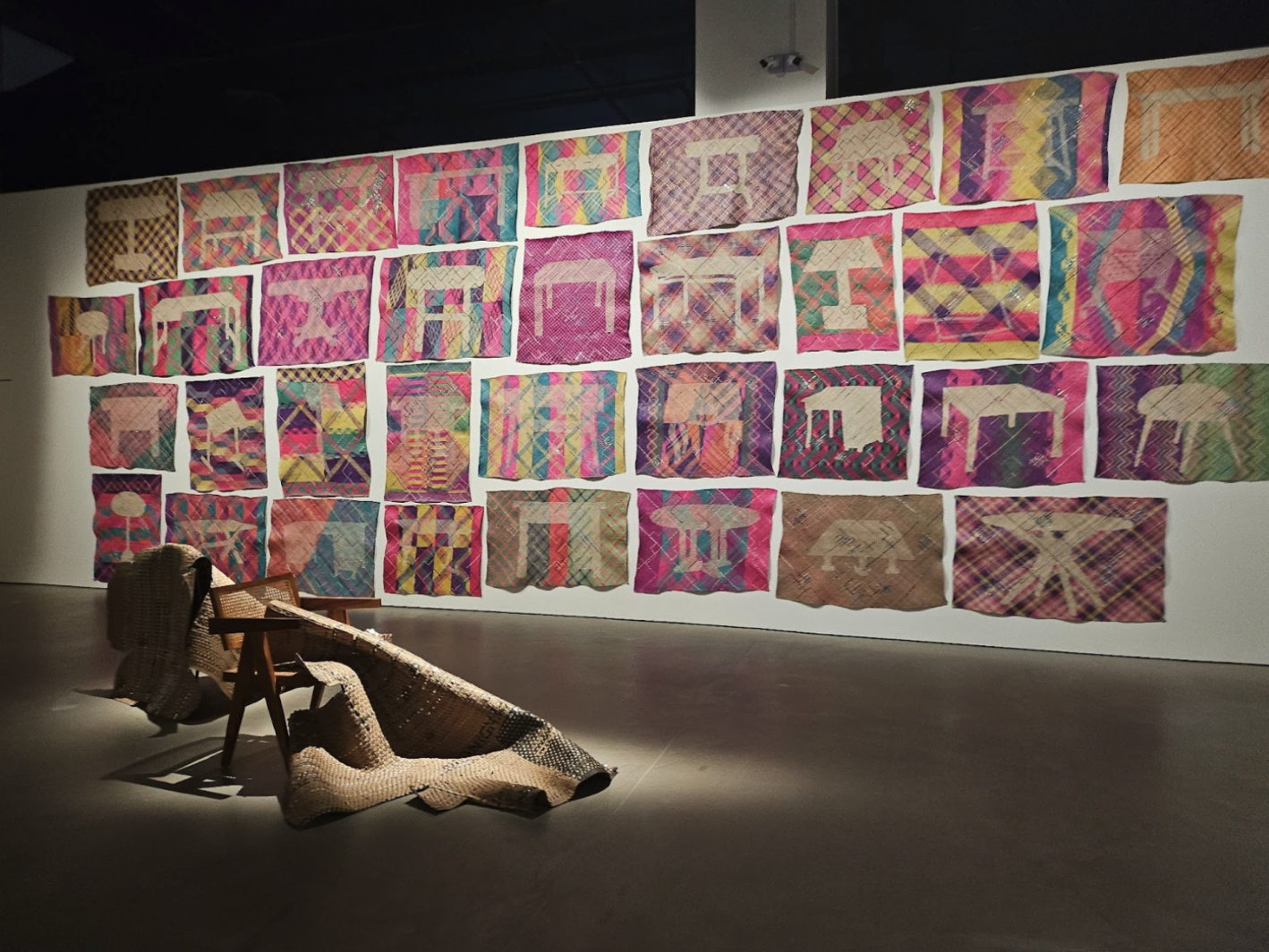
TIKAR/MEJA/PLASTIK, 2023, Pulau Omadal Bajau Sama Dilaut heritage pandanus weave, commercial chemical dye, collected plastic waste. Collection of the artist. Yee I-Lann: Mansau-Ansau (4 Dec 2024- 23 Mar 2025/ Singapore Art Museum)
Malaysian artist Yee I-Lann, invites us into these questions with her work TIKAR/MEJA, prompting us to reflect on how colonialism has shaped not only our living spaces, but the ways we perceive the world. Tikar refers to a traditional women's mat made from bamboo or pandan leaves. These are central to everyday life in the Nusantara region, including present-day Malaysia and Indonesia. People ate, slept, prayed, and even faced death on these mats. Unlike modern furniture designed for segmented functions, the Tikar accommodates many dimensions of life on a single flat surface. What Yee-I-Lann focuses on is this ‘flatness’. On the Tikar, everyone sits at the same level. Distinctions between center and periphery naturally blur.
Here, the Tikar is not simply a cultural artefact or a symbol of ‘traditional’ culture. Its making embodies a sense of time and a worldview distinct from Western rationality. Weaves do not measure mats in meters or feet, but by the length of their bodies – their own footsteps. With each step, they alternate between chanting allom (life) and amatai (death), always ending with life. Measurement becomes a bodily practice of remembering the cycle of existence – living and dying, rather than a detached technical process.
***
In contrast, the tables embroidered onto the mats function as tools that produce mechanical hierarchies. Tables create height, and height produces visible distinctions of power. Even the Malay word meja (table) is derived from the Portuguese mesa, revealing how tables entered daily life alongside colonialism. Under imperialism, floor-based living was labeled unhygienic and irrational. It was gradually replaced by tables and beds framed as symbols of modernity and civilization. The shift reshaped not only lifestyles, but also the very frameworks through which the world was perceived. Ways of living were reordered and ranked through colonial standards.
To recover the ways of knowing erased by the language of ‘modernization,’ Yee-I-Lan collaborated with the Banjau Sama DiLaut, an indigenous, sea-dwelling, stateless community in Southeast Asia who continue to live outside formal national systems even today. Through this collaboration, traditional crafts and artisans who were pushed to the margin by modernity are brought back into the space of contemporary art. Banjau women weavers produced Tikar, using techniques down through generations while incorporating plastic waste washing ashore into the materials, bringing sustainable development into the works. In this process, Tikar becomes a living practice, not a relic of the past.
***
This collaboration is not merely symbolic; it transforms the form and meaning of the work. Inside the exhibition space, the Tikar becomes an active intervention into colonial order through visual and spatial action. When the mat is rolled up, the embroidered table is literally “swallowed” by the Tikar. Through this simple gesture, the Tikar absorbs and destabilizes colonial hierarchies. From the ground position, Yee-I-Lann asks us to rethink what we take for granted: height and center, progress and modernity, and the standards by which value is measured.
***
Yee I-Lann (b. 1971, Kota Kinabalu, Sabah, Malaysia; lives and works in Kota Kinabalu) is a leading contemporary artist recognized for her predominantly photomedia-based practice. With acuity and wit, her digital photo collages delve into the evolving intersection of power, colonialism, and neo-colonialism in Southeast Asia, shedding light on the influence of historical memory in social experiences. Often centering on counter-narratives or ‘histories from below,’ she has recently begun collaborative work with sea-based and land-based communities, as well as indigenous mediums in Sabah, Malaysia.
Warmly,
Jeongwon Seo
Curator at the Busan Museum of Art
Jeongwon is interested in examining how capitalism shapes perception through propaganda, drawing on her studies in Business and Art Mediation.
Author: Jeongwon
Translator: Hyunjung
Editor: Lisa
Image: Jeongwon
