
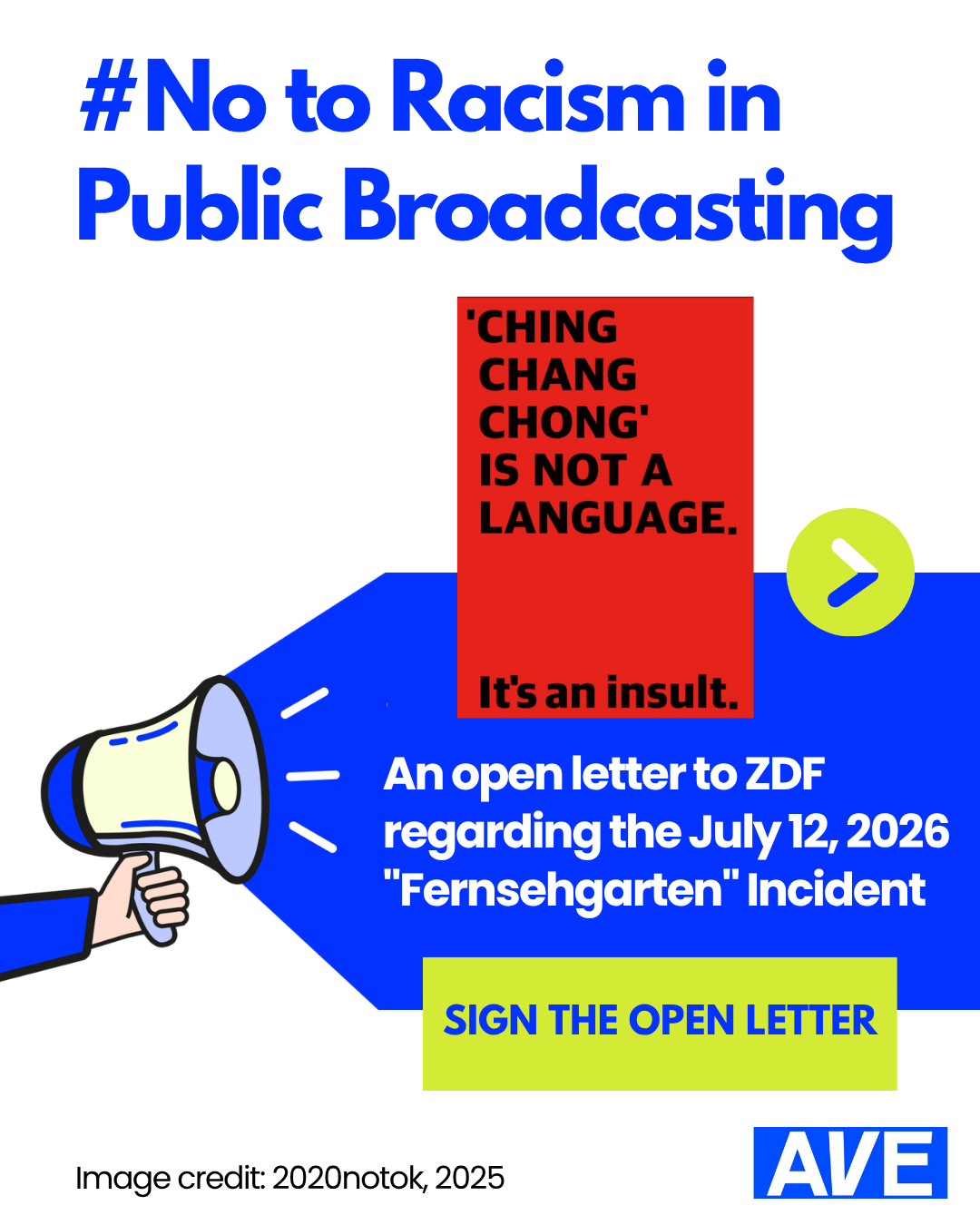
#Prime Time, No Hate Time
No to Racism in Public Broadcasting: An open letter to ZDF regarding the July 12, 2026 "Fernsehgarten" Incident
Final Update
28.09.2026
Dear Signatories,
Thank you for supporting our open letter to ZDF regarding the July 12, 2026 "Fernsehgarten" Incident. After finding the initial response from ZDF’s Director-General (Intendant) inadequate, we requested further review through its complaint procedure.
On 22 September, the ZDF complaint committee (Beschwerdeausschuss) unanimously dismissed the complaint as unfounded in the final notice. It confirmed the full Television Council (Fernsehrat) will therefore not consider the case.
The committee dismissed the complaint on the grounds that it identified no discriminatory intent in the sequences of sounds (“Lautfolge”), characterizing the remark as a thoughtless mistake (“unbedachte Äußerung”), citing the presenter’s explicit appreciation of anime films (“der ausdrücklichen Würdigung von Animé-Filmen”) as the reasoning of no discriminatory intent towards East Asian cultures (“keine diskriminierende Absicht gegenüber einzelnen ostasiatischen Kulturen erkennen”).
We are deeply disappointed with the committee's decision to not recognize this as an act of racism. The CCC-phrase is unequivocally racist and discriminatory against the Asian diaspora, regardless of intent. The presenter’s appreciation of anime films does not demonstrate an absence of discriminatory intent, nor does it excuse racist language. Framing an obvious racist remark as a sequence of sounds downplays this entire debacle, as racism does not require deliberate intent to cause harm. This decision reveals a troubling lack of awareness and a stark unwillingness on ZDF’s behalf to take any meaningful accountability against racism towards Asian people. It speaks volumes as to what ZDF’s values are.
Thank you for your time, solidarity, and your willingness to act. This complaint procedure may be over, but our commitment is not. We hope our collective voice will encourage lasting change and build greater awareness in the future.
With solidarity,
Asian Voices Europe

15.07.2026
-
1. “Ching Chong Chaang” on tax-funded daytime TV
On Sunday, July 12, 2026, the German public broadcaster ZDFaired a special episode on Fernsehgarten featuring Pokémon's 30th anniversary. The show’s host, Andrea Kiewel, interviewed two collectors who showcased their multilingual cards, with Kiewel reading the greetings on them one by one. When a Japanese card came up, however, she called it “the Chinese one”, followed by “Ching Chong Chaang”.
The clip went viral within hours, drawing widespread criticism on Kiewel’s remark as being racist. The Fernsehgarten Instagram account first responded with a simple comment. The following day, on July 13, a ZDF spokesperson issued a written statement to the German Press Agency (dpa), in which they stated that the remark was ‘due to the live situation’ and ‘by no means meant to be racist’. In the same statement, Kiewel stated that she “regretted her words”, and ZDF wrote that they "explicitly oppose any form of racism”.
2. Why this is structural racism
Despite ZDF’s apology, as of today, the July 12 broadcast of Fernsehgarten remains available in an open-access streaming library, without any edits to the original footage (such as an apology or removal of the problematic segment). The fact that such a problematic comment aired live on one of the longest-running flagship shows by a public broadcaster not only means that ZDF has violated its statutory mandate for non-discriminatory representation, but also that German citizens’ mandatory broadcasting fees are being used to perpetuate everyday racism.
Furthermore, ZDF’s framing of the incident as an “unfortunate live TV situation” amounts to a secondary microaggression, in an effort to minimize the harm they inflicted and to shift accountability. The statement issued on July 13 was nota live situation: the broadcaster had ample time to reflect and respond responsibly in written form.Inherent racist stereotypes are not technical accidents; they point to an underlying structural racist attitude towards non-German, non-European peoples and languages.
Racism is legally recognized in Germany as a structural social problem. Germany's federal government is currently updating its National Action Plan Against Racism (Nationaler Aktionsplan gegen Rassismus), as one of only 6 EU Member States to explicitly address anti-Asian racism as a form of discrimination. As a public broadcaster based in Germany, ZDF is bound by the following laws and regulations to protect the dignity of all regardless of race, ethnic origin, and language: The ZDF State Treaty, the Interstate Media Treaty of Germany, The German Press Code, The EU Audiovisual Media Services Directive, and the EU Charter of Fundamental Rights [see full list in Appendix].
As of today, ZDF has not responded to questions regarding concrete actions including disciplinary consequences and/or sensitivity training for Andreas Kiewel and/or its Fernsehgarten show staff.
3. ICYMI: Why saying “ching chang chong” is racist (in 2026)
Kiewel’s treatment of the European cards stands in direct contrast to her treatment of the Japanese card. All the European languages were treated as real and comprehensible. By contrast, the East Asian card, was mocked with gibberish sounds. For over a century, the gibberish "ching chang chong" has been used to make fun of Asian languages, assuming that they sound “ridiculous” or “unintelligible”. Mocking a language marks the people who speak it as less civilized and fundamentally foreign, which is precisely why it is still used today as a derogatory comment.
ZDF’s airing of this segment is not a “technical error”, but a manifestation of a historically rooted pattern of racist mockery, a pattern that was already part of the speaker’s everyday language. This is the textbook definition of normalized racism: a racist comment has become so “unremarkable” that both Kiewel and the studio air the segment with laughter bursting all around them. Nobody around them intervenes, amongst a crew of producers, reviewers, editors, or leadership.
4. Our demands to ZDF: Name, Train, Do Better
We are asking ZDF to treat this as a structural gap, not a single presenter’s bad moment. We are not asking for a symbolic gesture. Specifically, we call on ZDF to:
4.1 Issue an apology addressing the structural racism inside ZDF
We ask ZDF to publicly acknowledge in writing that the harm here was twofold: the on-air remark itself, and the low-effort response that followed it through third party channels. This will set a precedent for ZDF from repeating the same institutional pattern in the future.
4.2 Conduct concrete, verifiable anti-racism training within 2026-2027.
General references to “opposing racism” are not a plan. We ask for specific measures and remedies: mandatory training for on-air talent, editorial staff, and production leadership involved in live and pre-recorded formats; delivered by qualified external experts, including practitioners with lived expertise in anti-Asian racism specifically; on a recurring basis; with a public monitoring engagement. We demand that this be initiated before the end of the calendar year 2026.
4.3 Publish a transparent protocol for addressing discriminatory content
We ask ZDF to publish a clear process on how discriminatory content aired during live broadcasts will be addressed, including timelines for responses, criteria for when content is edited or contextualized after the fact, and a named point of accountability within the organization. ZDF is funded by mandatory public broadcasting fees and operates under a statutory mandate that includes fair and non-discriminatory representation. That mandate carries a higher duty of care than a private broadcaster would owe its audience. We expect ZDF’s responses to reflect that on whether existing safeguards for live programming are adequate.
We look forward to a substantive response addressing each of the points above by July 31, 2026.
Signed,
Asian Voices Europe (Den Haag/Leipzig)
Appendix: List of laws and regulations prohibiting discrimination
Discrimination based on race, ethnicity, and national origin is also explicitly and specifically named as prohibited in laws relating to citizens’ rights in Germany:
The Interstate Media Treaty’s principles §8 explicitly prohibit content that promotes discrimination on the basis of race or ethnic origin.
The German Press Code §12 states plainly that no one may be discriminated against on the basis of ethnic or national group membership.
The EU Charter of Fundamental Rights (§21) prohibits discrimination on grounds including race, ethnic origin, and language.
Human dignity must be actively protected in programming at every level of the regulatory stack:
The ZDF-Staatsvertrag (§4), the treaty that legally establishes and governs ZDF, obligates the broadcaster to respect and protect human dignity in its programming. The ZDF-Staatsvertrag §4 is a standard independent of intent.
The Interstate Media Treaty (Medienstaatsvertrag) imposes the aforementioned duty on every nationwide public broadcaster in Germany.
The EU Audiovisual Media Services Directive (AVMS; 2010/13/EU, as amended by 2018/1808) requires the same protection of human dignity across all EU member states' audiovisual content.
The EU Charter of Fundamental Rights (Article 1) guarantees human dignity as inviolable. The principle of both the AVMS Directive and German broadcasting law translate into the binding media specific duty.
***
We demand accountability, action, and a public commitment to end anti-Asian racism in all forms.
We invite civil society organizations, institutions, groups, and individuals to endorse this open letter as co-signatories, after its publication.
#PrimeTimeNoHateTime
Contact email address: asianvoiceseurope@gmail.com
Link to the open letter: https://forms.gle/6C61yk3nDAVnbCJ27
-
公共廣播電視不容種族歧視:就2026年7月12日Fernsehgarten事件致ZDF的公開信黃金時段,不容種族歧視
1. 「Ching Chong Chaang」:由公帑資助的公共廣播節目出現種族歧視言論
2026 年 7 月 12 日(星期日),德國公共廣播機構 ZDF 的長壽綜藝節目《Fernsehgarten》播出了一個 Pokémon(寶可夢)30 週年紀念單元。節目中,主持人 Andrea Kiewel 訪問兩位 Pokémon 收藏家,兩人展示了不同語言版本的 Pokémon 收藏卡。Kiewel 逐一讀出卡片上的問候語,當展示一張日文卡時,她先誤稱其為「中文卡」,隨後更模仿中文發音,說出帶有種族歧視意味的 「Ching Chong Chaang」。
相關片段在數小時內於網上廣泛流傳,引起大量公眾批評,認為 Kiewel 的言論帶有反亞裔種族歧視色彩。Fernsehgarten 官方 Instagram 帳號最初僅以簡短留言回應。翌日(7月13日),ZDF 發言人向德新社(dpa)發表書面聲明,表示該言論是直播期間的「一時口誤」(slip in the live situation),並強調「絕無種族歧視之意」。同一份聲明中,Kiewel 表示自己「對當時的措辭感到懊悔」,ZDF 則重申「堅決反對任何形式的種族主義」。
2. 這宗事件反映了結構性種族主義
儘管 ZDF 已就事件作出道歉,但截至本公開信發布之日,7 月 12 日播出的節目完整版仍可於公開串流平台觀看,原始內容未經任何編輯處理,既未加註道歉或說明,也未移除涉歧視的片段。
如此帶有種族歧視色彩的言論,竟能在公共廣播機構旗下歷史最悠久的旗艦節目之一於直播中播出,這不僅意味著 ZDF 違反了其依法負有的非歧視性呈現義務 (non-discriminatory representation),也意味著德國民眾依法繳納的公共廣播費,正被用於延續日常生活中的種族主義。
此外,ZDF 將事件歸因於「直播中的一時失誤」(slip in the live situation),本身亦是一種次級隱性歧視(secondary microaggression):透過淡化事件的嚴重性,削弱受影響群體所承受的傷害,同時將焦點轉移至直播環境,而非反思事件背後所反映的制度問題。
值得注意的是,7 月 13 日發表的書面聲明並非直播當下的即時回應,而是在事發後經過一天時間所作出的正式回應。換言之,ZDF 有充分時間審慎評估事件及其影響。然而,其回應仍將事件描述為單純的「失誤」,而未正視問題背後所反映的反亞裔種族主義及制度性偏見。
根深蒂固的種族刻板印象並非技術性錯誤,而是對非德國、非歐洲族群及其語言長期存在的偏見所造成的結果。
在德國法律及政策框架下,種族主義被明確認定為一項結構性的社會問題。德國聯邦政府目前正修訂《全國反種族主義行動計畫》(Nationaler Aktionsplan gegen Rassismus),而德國亦是歐盟 27 個成員國中,少數將反亞裔種族主義明確納入政策處理範圍的國家之一。
作為德國的公共廣播機構,ZDF 有責任依據相關法律及專業規範,保障所有人的人格尊嚴,不因種族、族裔背景或語言而受到歧視。相關法律與規範包括:《ZDF 國家條約》(ZDF-Staatsvertrag)、《媒體州際條約》(Medienstaatsvertrag, MStV)、《德國新聞守則》(Pressekodex)、《歐盟影音媒體服務指令》(Audiovisual Media Services Directive, AVMSD),以及《歐盟基本權利憲章》(Charter of Fundamental Rights of the European Union)(完整法規清單請參閱附錄)。
截至目前,ZDF 仍未公布任何具體改善措施,包括是否就事件對 Andrea Kiewel 或《Fernsehgarten》製作團隊展開內部調查或紀律程序,以及是否會推行相關的反種族主義或文化敏感度培訓。
3. 延伸說明:為何「Ching Chong Chaang」至今仍屬於種族歧視言論
Kiewel 對待歐洲語言卡與日文卡的方式形成鮮明對比。面對歐洲語言時,她將每一種語言都視為真實且值得尊重的語言,並嘗試讀出卡片上的內容;然而,當展示一張日文卡時,她卻先誤稱其為「中文」,隨後更以毫無意義的擬聲詞 「Ching Chong Chaang」 加以模仿和嘲弄。
一個多世紀以來,「Ching Chong」一直被用作嘲笑中文及其他東亞語言的種族歧視用語,藉此將這些語言描繪成滑稽、難懂或毫無意義的聲音。這種做法不只是嘲笑一種語言,更是否定其文化與使用者的尊嚴,將說這些語言的人標籤為「未開化」、「外來者」或「不屬於我們的人」。正因如此,「Ching Chong」至今仍被廣泛視為帶有侮辱性的種族歧視表述。
ZDF 播出這段內容並非所謂的「技術性失誤」,而是歷史悠久的種族嘲弄模式在公共媒體中的體現;這種模式早已被內化,並成為講者日常語言表達的一部分。更值得關注的是,這句帶有種族歧視色彩的言論在直播過程中,不但沒有引起任何人質疑,反而伴隨現場笑聲順利播出。主持人、製作團隊、編輯、審核人員及節目管理層,均未有人即時介入或制止。
這正是結構性種族主義(structural racism)的典型表現。 當一種針對特定族群的歧視言論變得如此習以為常,以致整個製作團隊都未能察覺其問題,甚至將其視為無傷大雅的玩笑時,種族主義便已不再只是個人的偏見,而是深植於制度、文化與媒體實踐之中的常態。
4. 我們對 ZDF 的訴求:正視、培訓、改進
我們呼籲 ZDF 不應淡化事件,亦不應將其歸因於個別主持人的個人失言,而應正視事件背後所反映的制度性問題。
我們提出的訴求並非象徵性的表態,而是具體、可衡量及可追蹤的改善措施:
4.1 就 ZDF 內部存在的結構性種族主義問題作出正式回應
我們要求 ZDF 以書面形式公開承認,本次事件所造成的傷害具有雙重層面:
第一,是直播過程中出現的歧視性言論本身;
第二,是事件發生後,ZDF 透過第三方渠道作出的回應未能充分正視事件所造成的傷害。
我們要求 ZDF 以此為鑑,嚴肅審視自身制度、工作流程及節目製作文化,並採取措施防止同樣的制度性問題再次發生。
4.2 於 2026 至 2027 年度內實施具體、可查核的反種族主義培訓
只重申「反對種族主義」的立場,並不足以構成有效的改善方案。我們要求 ZDF 制定具體補救措施,包括:
為參與直播及預錄節目製作的主持人、幕前工作人員、編輯團隊及製作管理層提供強制性反種族主義培訓;
培訓應由具備相關專業資格的外部專家主持,其中包括在反亞裔種族歧視領域具有豐富實務經驗的專業人士;
培訓應以定期及持續的方式推行,並建立公開透明的監督及評估機制。
我們要求相關培訓計畫最遲於 2026 年底前正式啟動。
4.3 制定並公開應對歧視性內容的透明處理程序
我們要求 ZDF 公開一套明確的處理流程,說明未來如直播節目中出現歧視性內容時,將如何應對,包括:
事件發生後的回應時限;
事後對相關內容進行編輯、更正或補充背景說明的具體標準;
機構內負責統籌及承擔責任的明確聯絡人或部門。
ZDF 依靠德國民眾依法繳納的公共廣播費(Rundfunkbeitrag)運作,並受法定公共服務使命約束,其中包括確保公平及非歧視性的媒體呈現。相較於私人廣播機構,ZDF 所承擔的公共責任要求其對觀眾負有更高程度的謹慎義務。
我們期待 ZDF 認真檢視現有直播節目的監督及防範機制是否足以避免歧視性內容播出,並就此作出具體回應。
我們期待 ZDF 於本公開信發布日起兩週內,就上述各項訴求逐一作出實質回應。
發起組織:
歐洲亞裔之聲(Asian Voices Europe)
(海牙/萊比錫)
附錄:禁止歧視相關法律及規範清單
在德國,基於種族、族裔背景及國籍而作出的歧視行為,亦被多項保障公民權利的法律及規範明確禁止。
一、禁止基於種族、族裔及國籍背景的歧視
《媒體州際條約》(Medienstaatsvertrag, MStV)第 8 條明確禁止傳播鼓吹基於種族或族裔背景而產生歧視的內容。
《德國新聞守則》(Pressekodex)第 12 條明確指出,不得因個人的族裔或國籍群體歸屬而對其作出歧視。
《歐盟基本權利憲章》(Charter of Fundamental Rights of the European Union)第 21 條禁止基於包括種族、族裔背景及語言等理由的歧視。
二、節目製作各層面均負有積極維護人格尊嚴的責任
人格尊嚴的保障並非僅限於避免明確的歧視意圖,而應在媒體監管及節目製作的各個層面被積極維護:
《ZDF 國家條約》(ZDF-Staatsvertrag)第 4 條:作為規範及設立 ZDF 的法律依據,該條約要求 ZDF 在節目內容中尊重並保障人格尊嚴。該條款所要求的標準,並不取決於節目製作相關人員是否具有歧視意圖。
《媒體州際條約》(Medienstaatsvertrag, MStV):該條約將上述維護人格尊嚴的責任延伸至德國所有全國性公共廣播機構。
《歐盟影音媒體服務指令》(Audiovisual Media Services Directive, AVMSD;2010/13/EU,經 2018/1808 修訂):該指令要求所有歐盟成員國的影音媒體內容均須遵守對人格尊嚴的保障。
《歐盟基本權利憲章》(Charter of Fundamental Rights of the European Union)第 1 條:保障人格尊嚴不可侵犯。AVMSD 及德國廣播法中的相關原則,進一步轉化為適用於媒體領域的具體法律義務。
[Translators: Kennis Mohrbach & Chenyue Li]
-
公共广播电视拒绝种族主义:就2026年7月12日Fernsehgarten事件致ZDF的公开信精彩黄金档,仇恨请离场
1. "Ching Chong Chaang":强制性广播费资助的日间电视节目中出现种族歧视用语
2026年7月12日周日,德国公共广播机构ZDF播出经典综艺节目Fernsehgarten宝可梦(Pokémon)30周年特别篇。节目主持人Andrea Kiewel采访了两位收藏爱好者,二人展示了多语种宝可梦收藏卡牌,Kiewel逐一朗读卡牌上的问候语。当展示一张日文卡牌时,她先是误称其为"中文卡牌",随即使用了带有种族歧视色彩的拟声嘲讽用语"Ching Chong Chaang"。该视频片段在数小时内于网络上广泛传播,大量公众谴责Kiewel的言论涉嫌种族歧视。Fernsehgarten官方Instagram账号最初仅以一条简短评论作出回应。次日,即7月13日,ZDF发言人向德新社(dpa)递交书面声明,辩称该言论"源于直播临场情景","绝无种族歧视之意"。在同一份声明中,Kiewel表示"对自己的措辞感到懊悔",ZDF亦声明"坚决反对一切形式的种族主义"。
2. 为何本次事件反映的是结构性种族主义问题
尽管ZDF已作出道歉,但截至本公开信发布之日,7月12日播出的这期节目完整版仍可在公开流媒体平台观看,原始画面未经任何编辑处理(既未附加致歉说明,亦未删除涉歧视片段)。这样一段有问题的言论能够在该公共电视台最长寿的王牌节目之一的直播中播出,不仅意味着ZDF违背了其关于公平、无差别呈现各族群文化的法定职责,也意味着德国民众依法缴纳的强制性广播电视规费,正被用于延续日常生活中的种族主义。
此外,ZDF将此事定性为"直播中的意外情况",此举本身构成一种二次隐性歧视(secondary microaggression),意在淡化其造成的伤害并转移责任。7月13日发布的书面声明并非临场即兴表态:该广播机构本有充分时间审慎考虑,并以书面形式作出负责任的回应。根深蒂固的种族刻板印象并非技术性失误,而是反映出其对非德国、非欧洲族群及其语言所抱持的深层结构性种族主义态度。
在德国法律体系中,种族主义被明确认定为一种结构性社会问题。德国联邦政府目前正在修订《全国反种族主义行动计划》(Nationaler Aktionsplan gegen Rassismus),德国也是欧盟27个成员国中,仅有的六个将反亚裔种族歧视明确列为一种歧视类型加以处理的国家之一。作为德国本土公共广播机构,ZDF受以下法律法规约束,须维护所有族群不因种族、民族出身及语言而受损其人格尊严:《ZDF国家条约》(ZDF-Staatsvertrag)、《德国跨州媒体条约》(Medienstaatsvertrag, MStV)、《德国新闻从业准则》(Pressekodex)、《欧盟视听媒体服务指令》(Audiovisual Media Services Directive, AVMSD),以及《欧盟基本权利宪章》(Charter of Fundamental Rights of the European Union)(完整法规名录见附录)。
截至目前,ZDF仍未就具体整改措施作出答复,包括是否对Andrea Kiewel及/或Fernsehgarten制作团队启动纪律处分,以及是否开展相关敏感性培训。
3. 延伸说明:为何在2026年,使用"ching chang chong"仍属种族歧视表述
Kiewel对待欧洲语种卡牌与日文卡牌的态度形成鲜明对比:所有的欧洲语言都会被当成真正的、听得懂的语言去对待;而面对这张东亚语种卡牌时,却以毫无意义的拟声词汇加以嘲弄。一个多世纪以来,"ching chang chong"这一无意义的拟声词一直被用于取笑亚洲语言,暗示其发音"荒谬"或"不知所云"。踩一贬一地去丑化一种语言,本质上就是把说这种语言的人贴上“没开化”和“非我族类”的标签。而这,也恰恰是为什么直到今天,这个词依然被当作侮辱性词汇来使用的原因。
Fernsehgarten播出该片段并非"技术性失误",而是一种历史悠久的种族嘲弄模式的体现,这一模式早已成为主持人日常表达的一部分。这正是常态化种族主义的典型例证:一句种族歧视言论已经变得如此"稀松平常",以至于Kiewel本人与整个演播现场都在笑声中将该片段播出。在场的制作人员、审核人员、剪辑人员及管理层,竟无一人出面制止。
4. 我方对ZDF的诉求:正视,培训,改进
我们呼吁 ZDF 不要避重就轻,必须正视这背后存在的系统性缺陷,而非仅归咎于某位主持人的个人失言。我方所诉求的并非象征性表态,具体诉求如下:
4.1 就ZDF内部存在的结构性种族主义问题发表正式道歉
我们要求ZDF以书面形式公开承认,本次事件所造成的伤害是双重的:其一为直播现场的歧视性言论本身,其二为其后通过第三方渠道作出的敷衍回应。通过对此事的严肃处理,对ZDF形成警示,防止今后再度出现同类体制性错误。
4.2 于2026至2027年度内开展具体、可核查的反种族主义培训
泛泛地重申"反对种族主义"的立场,并不构成一项切实可行的整改方案。我方要求出台具体的补救措施:对参与直播及预录节目制作的出镜人员、编辑团队及制作管理层实施强制性培训;培训应由合格的外部专家主持,其中须包括在反亚裔种族歧视领域具有丰富实务经验的专业人士;培训应定期、常态化开展,并配以公开的监督机制。我方要求该培训项目于2026年底前正式启动。
4.3 公布处理歧视性内容的透明工作流程
我们要求 ZDF 公开一套明确的流程,明确以后直播里要是再出现歧视性内容,到底该怎么处理,包括多长时间内给出回应、事后删改或澄清争议内容的具体标准是什么,以及到底由谁来出面牵头负责。
ZDF 依靠全德纳税人强制缴纳的电视费,肩负“公平、无歧视报道”的法定义务。作为公共电视台的代表,相比私营电视台应该发言更严谨、对观众更负责任。 我们希望 ZDF 能拿出该有的态度,好好反思现有的直播安全机制到底够不够用。
我们要求ZDF在【本公开信发布之日起两周内】,就以上各项诉求逐一作出实质性回应
签署人:欧洲亚裔之声(Asian Voices Europe)(海牙/莱比锡)
[Translators: Chenyue Li & Riya Guo]
-
Nein zu Rassismus im öffentlich-rechtlichen Rundfunk: Ein offener Brief an das ZDF zum Vorfall im "Fernsehgarten" vom 12. Juli 2026
1. "Ching Chong Chaang" im gebührenfinanzierten Tagesprogramm
Am Sonntag, dem 12. Juli 2026, strahlte der deutsche öffentlich-rechtliche Sender ZDF eine Sonderausgabe des Fernsehgartens zum 30-jährigen Jubiläum von Pokémon aus. Die Moderatorin der Sendung, Andrea Kiewel, interviewte zwei Sammler, die ihre mehrsprachigen Karten vorstellen, wobei Kiewel die darauf enthaltenen Grüße nacheinander vorlas. Als jedoch eine japanische Karte an die Reihe kam, bezeichnete sie diese als „die Chinesische", gefolgt von den Worten „Ching Chong Chaang”.
Der Clip verbreitete sich innerhalb weniger Stunden viral und löste Kritik an Kiewels rassistischer Äußerung aus. Der Instagram-Account des Fernsehgartens reagierte zunächst mit einem knappen Kommentar. Am Folgetag, dem 13. Juli, gab eine ZDF-Sprecherin gegenüber der Deutschen Presse-Agentur (dpa) eine schriftliche Stellungnahme ab, in der es hieß, die Äußerung sei „der Live-Situation geschuldet” und „keinesfalls rassistisch gemeint” gewesen. In derselben Stellungnahme erklärte Kiewel, sie „bedauere ihre Worte”, und das ZDF schrieb, man „distanziere sich ausdrücklich von jeglicher Form von Rassismus”.
2. Warum es sich um strukturellen Rassismus handelt
Trotz der Entschuldigung des ZDF ist die Sendung vom 12. Juli in der frei zugänglichen Mediathek nach wie vor unverändert abrufbar - ohne jegliche Bearbeitung des Originalmaterials, etwa in Form eines Hinweises oder der Entfernung der betreffenden Passage. Dass eine derart problematische Äußerung live in einem der am längsten laufenden Hauptformate eines öffentlich-rechtlichen Senders ausgestrahlt wurde, bedeutet nicht nur, dass das ZDF seinem gesetzlichen Auftrag zur diskriminierungsfreien Darstellung nicht gerecht geworden ist, sondern auch, dass die verpflichtenden Rundfunkbeiträge der deutschen Bürgerinnen und Bürger zur Fortschreibung alltäglichen Rassismus beigetragen haben.
Darüber hinaus stellt die Einordnung des Vorfalls durch das ZDF als „unglückliche Live-Situation” eine sekundäre Mikroaggression dar, mit der versucht wird, den angerichteten Schaden zu relativieren und Verantwortung abzuwälzen. Die am 13. Juli veröffentlichte Stellungnahme war keine Live-Situation: Dem Sender stand ausreichend Zeit zur Verfügung, um zu reflektieren und in schriftlicher Form angemessen zu reagieren. Rassistische Stereotype dieser Art sind keine technischen Pannen. Sie verweisen auf eine zugrunde liegende strukturell-rassistische Haltung gegenüber nicht-deutschen, nicht-europäischen Kulturen und Sprachen.
Rassismus ist in Deutschland rechtlich als strukturelles gesellschaftliches Problem anerkannt. Die Bundesregierung überarbeitet derzeit ihren Nationalen Aktionsplan gegen Rassismus, wobei Deutschland zu den lediglich sechs EU-Mitgliedstaaten zählt, die anti-asiatischen Rassismus ausdrücklich als eigenständige Diskriminierungsform benennen. Als in Deutschland ansässiger öffentlich-rechtlicher Sender ist das ZDF durch folgende Gesetze und Regelwerke verpflichtet, die Würde aller Menschen unabhängig von Herkunft, ethnischer Zugehörigkeit und Sprache zu schützen: den ZDF-Staatsvertrag, den Medienstaatsvertrag, den Pressekodex, die EU-Richtlinie über audiovisuelle Mediendienste sowie die Charta der Grundrechte der Europäischen Union [siehe Anhang für die vollständige Liste].
Bis heute hat sich das ZDF nicht zu Fragen konkreter Konsequenzen geäußert, darunter mögliche disziplinarische Maßnahmen und/oder Sensibilisierungsschulungen für Andrea Kiewel und/oder das Team des Fernsehgartens.
3. Zur Erinnerung: Warum "Ching Chang Chong" rassistisch ist (im Jahr 2026)
Kiewels Umgang mit den europäischen Karten steht in deutlichem Gegensatz zu ihrem Umgang mit der japanischen Karte. Alle europäischen Sprachen wurden als real und verständlich behandelt. Die ostasiatische Karte hingegen wurde mit sinnlosen Lautfolgen verspottet. Seit über einem Jahrhundert wird das Kauderwelsch „Ching Chang Chong” verwendet, um sich über asiatische Sprachen lustig zu machen - unter der Annahme, diese klängen „lächerlich” oder „unverständlich”. Sprachen zu verspotten, stigmatisiert die Sprechenden als weniger zivilisiert und als grundsätzlich fremd. Genau deshalb wird diese Verunglimpfung bis heute verwendet.
Die Ausstrahlung dieser Sequenz durch das ZDF ist kein „technischer Fehler”, sondern Ausdruck eines historisch verwurzelten Musters rassistischer Verspottung - eines Musters, das offenkundig bereits Teil der alltäglichen Sprache der Moderatorin war. Dies ist ein Lehrbuchbeispiel für normalisierten Rassismus: eine rassistische Äußerung ist so „unauffällig” geworden, dass sowohl Kiewel als auch das Studio die Sequenzen unter allgemeinem Gelächter ausstrahlen. Niemand greift ein - weder aus dem Kreis der Produzentinnen und Produzenten noch der Redaktion oder der verantwortlichen Leitungsebene.
4. Unsere Forderungen an das ZDF: Benennen, Schulen, Besser machen
Wir fordern das ZDF auf, diesen Vorfall als strukturelles Defizit zu behandeln - nicht als den bedauerlichen Moment einer einzelnen Moderatorin. Wir fordern keine symbolische Geste. Konkret fordern wir vom ZDF:
4.1 Eine Entschuldigung, die den strukturellen Rassismus innerhalb des ZDF benennt
Wir fordern das ZDF auf, öffentlich und schriftlich anzuerkennen, dass hier ein zweifacher Schaden entstanden ist: durch die Äußerung selbst und durch die unzureichende Reaktion, die anschließend über Drittkanäle erfolgte. Dies soll einen Präzedenzfall schaffen, damit sich dieses institutionelle Muster beim ZDF künftig nicht wiederholt.
4.2 Konkrete, überprüfbare Anti-Rassismus-Schulungen im Zeitraum 2026-2027
Allgemeine Bekundungen, man „lehne Rassismus ab”, stellen keinen Plan dar. Wir fordern spezifische Maßnahmen: verpflichtende Schulungen für Moderationspersonal, Redaktion und Produktionsleitung, die an Live- und aufgezeichneten Formaten beteiligt sind; durchgeführt von qualifizierten externen Fachkräften, einschließlich Personen mit gelebter Erfahrung im Bereich anti-asiatischen Rassismus; auf wiederkehrender Basis; mit öffentlich einsehbarer Begleitung. Wir fordern, dass diese Maßnahmen noch vor Ende des Kalenderjahres 2026 eingeleitet werden.
4.3 Veröffentlichung eines transparenten Protokolls zum Umgang mit diskriminierenden Inhalten
Wir fordern das ZDF auf, ein klares Verfahren zu veröffentlichen, wie diskriminierende Inhalte, die während Live-Sendungen ausgestrahlt werden, künftig behandelt werden - einschließlich Reaktionszeiten, Kriterien dafür, wann Inhalte nachträglich bearbeitet oder eingeordnet werden, sowie einer benannten verantwortlichen Stelle innerhalb der Organisation. Das ZDF wird durch verpflichtende Rundfunkbeiträge finanziert und unterliegt einem gesetzlichen Auftrag zur fairen und diskriminierungsfreien Darstellung. Dieser Auftrag begründet eine höhere Sorgfaltspflicht, als sie ein privater Sender gegenüber seinem Publikum hätte. Wir erwarten, dass die Antworten des ZDF erkennen lassen, ob die bestehenden Schutzmechanismen für Live-Programme angemessen sind.
Wir erwarten eine inhaltliche Stellungnahme zu den vorgenannten Punkten bis zum 31. Juli 2026 entgegen.
Mit freundlichen, aber bestimmten Grüßen,
Asian Voices Europe (Den Haag/Leipzig)
#Meine Gebühr Meine Würde
Anhang: Übersicht der Gesetze und Regelwerke zum Diskriminierungsschutz
Diskriminierung aufgrund von Rasse, ethnischer Herkunft und nationaler Zugehörigkeit ist zudem ausdrücklich und spezifisch in folgenden Gesetzen zum Schutz der Bürgerrechte in Deutschland untersagt:
§8 des Medienstaatsvertrags untersagt ausdrücklich Inhalte, die Diskriminierung aufgrund von Rasse oder ethnischer Herkunft fördern.
§12 des Pressekodex stellt unmissverständlich klar, dass niemand aufgrund der Zugehörigkeit zu einer ethnischen oder nationalen Gruppe diskriminiert werden darf.
Die Charta der Grundrechte der Europäischen Union (Art. 21) verbietet Diskriminierung unter anderem aufgrund von Rasse, ethnischer Herkunft und Sprache.
Die Menschenwürde muss auf jeder Ebene der programmlichen Verantwortung aktiv geschützt werden:
Der ZDF-Staatsvertrag (§4), der den Sender rechtlich begründet und regelt, verpflichtet das ZDF, die Menschenwürde in seiner Programmgestaltung zu achten und zu schützen. §4 des ZDF-Staatsvertrags gilt unabhängig von der Absicht.
Der Medienstaatsvertrag begründet dieselbe Pflicht für sämtliche bundesweit ausstrahlenden öffentlich-rechtlichen Sender in Deutschland.
Die EU-Richtlinie über audiovisuelle Mediendienste (AVMD-Richtlinie; 2010/13/EU, geändert durch 2018/1808) verlangt denselben Schutz der Menschenwürde für audiovisuelle Inhalte in allen EU-Mitgliedstaaten.
Die Charta der Grundrechte der Europäischen Union (Art. 1) garantiert die Unantastbarkeit der Menschenwürde. Der Grundsatz sowohl der AVMD-Richtlinie als auch des deutschen Rundfunkrechts übersetzt sich in eine bindende medienspezifische Pflicht.
-
Non au racisme dans le paysage audiovisuel public : Lettre ouverte à la ZDF concernant l’incident du 12 juillet 2026 dans l’émission « Fernsehgarten »
# Pas d'audience pour le racisme
1. « Ching Chong Chaang » à une heure de grande écoute sur une chaine publique
Ce dimanche 12 juillet 2026, la chaîne publique allemande ZDF a consacré un épisode spécial de l’émission de divertissement « Fernsehgarten » au 30e anniversaire de Pokémon. La présentatrice de l’émission, Andrea Kiewel, a interviewé deux collectionneuses qui ont présenté leurs cartes venant de différents pays, tandis que Kiewel lisait les messages inscrits sur chacune. Mais arrivée à une carte japonaise, elle y a fait référence comme étant « la chinoise », avant d’ajouter « Ching Chong Chaang ».
L’extrait est devenu viral en quelques heures, suscitant des critiques généralisées face à la remarque de Kiewel, jugée raciste. Le compte Instagram de « Fernsehgarten » a dans un premier temps réagi par un simple commentaire. Le lendemain, le 13 juillet, un porte-parole de la chaîne de télévision ZDF a publié un communiqué à l’attention de l’Agence de presse allemande (dpa), stipulant que la remarque était « due au contexte du direct » et « n’avait en aucun cas de connotation raciste ». Dans ce même communiqué, Kiewel a déclaré qu’elle « regrettait ses propos » et la ZDF a précisé qu’elle « s’opposait de manière explicite à toute forme de racisme ».
2. Pourquoi il s’agit de racisme structurel
Malgré les excuses de la ZDF, l'émission « Fernsehgarten » du 12 juillet reste encore à ce jour en libre accès et disponible en streaming, sans qu’aucune modification (ajout d'excuses ou suppression du passage problématique) n'ait été apportée aux images originales. Le fait qu’un commentaire aussi problématique ait été diffusé en direct dans l’une des émissions emblématiques les plus anciennes d’une chaîne publique signifie non seulement que la ZDF a enfreint son obligation légale de représentation non discriminatoire, mais aussi que la taxe de redevance audiovisuelle versée par la population allemande sert à perpétuer le racisme ordinaire.
De plus, le fait que la ZDF présente l’incident comme un « regrettable imprévu du direct » équivaut à une seconde micro-agression, visant à minimiser le préjudice causé et à se décharger de toute responsabilité. Le communiqué publié le 13 juillet n’était pas un imprévu du direct : la chaîne avait amplement le temps de réfléchir et de réagir de manière responsable par écrit. Les stéréotypes racistes inhérents ne sont pas des incidents techniques ; ils révèlent une attitude raciste structurelle sous-jacente vis-à-vis des populations et des langues qui ne sont pas allemandes ou européennes.
En Allemagne, le racisme est légalement reconnu comme un problème structurel. Le gouvernement fédéral allemand procède actuellement à la mise à jour de son Plan d’Action National contre le Racisme (Nationaler Aktionsplan gegen Rassismus), l’Allemagne étant l’un des six seuls États membres de l’UE à aborder explicitement le racisme anti-asiatique comme une forme de discrimination. En tant que chaîne publique basée en Allemagne, la ZDF est tenue de protéger la dignité de toutes et tous sans distinction de race, d’origine ethnique et de langue, en vertu des lois et réglementations suivantes : le Traité d’États de la ZDF (ZDF-Staatsvertrag), le Traité interétatique allemand sur les médias (Medienstaatsvertrag, MStV), le Code de la presse allemande (Pressekodex), la Directive européenne sur les services de médias audiovisuels (Audiovisual Media Services Directive, AVMSD) et la Charte des droits fondamentaux de l’UE (Charter of Fundamental Rights of the European Union) [voir la liste complète en annexe].
À ce jour, la ZDF n’a pas répondu aux interrogations concernant les mesures concrètes envisagées, notamment les sanctions disciplinaires et/ou une formation de sensibilisation pour Andrea Kiewel et/ou l’équipe de l’émission « Fernsehgarten ».
3. Pour rappel : pourquoi dire « ching chang chong » est raciste (en 2026)
La façon dont Kiewel aborde les cartes européennes contraste fortement avec la manière dont elle aborde la japonaise. Toutes les langues européennes ont été présentées de manière réaliste et compréhensible. En revanche, la carte d’Asie de l’Est a été tournée en dérision par l’utilisation de sons incohérents. Depuis plus d’un siècle, le charabia « ching chang chong » est utilisé pour se moquer des langues asiatiques, partant du principe qu’elles semblent « ridicules » ou « inintelligibles ». Tourner une langue en dérision revient à considérer les populations qui la parlent comme moins civilisées et fondamentalement étrangères, ce qui explique précisément pourquoi cette expression désobligeante est encore utilisée aujourd’hui.
La diffusion de cet extrait dans l’émission « Fernsehgarten » n’est pas une « erreur technique », mais bien la manifestation d’un schéma historiquement ancré de moquerie raciste, un schéma qui était déjà intégré dans le langage quotidien de la présentatrice. C’est la définition même du racisme ordinaire : un commentaire raciste est devenu si « banal » que Kiewel et l’équipe du studio diffusent l’extrait avec un grand éclat de rire. Et personne autour d’eux – que ce soit l’équipe de production, les critiques, l’équipe de montage ou la direction – n’intervient.
4. Nos demandes vis-à-vis de la ZDF : reconnaissez les faits, formez-vous, faites mieux à l’avenir
Nous demandons à la ZDF de considérer cet incident comme une lacune structurelle et non comme le faux pas individuel d’une présentatrice. Nous ne demandons pas de geste symbolique. Plus précisément, nous appelons la ZDF à :
4.1 Présenter des excuses par rapport au racisme structurel au sein de la ZDF
Nous demandons à la ZDF de reconnaître publiquement et par écrit que le préjudice causé est double : la remarque diffusée à l’antenne en tant que telle et la réaction insuffisante qui a, par la suite, été partagée via des canaux tiers. Cela constituera un précédent pour éviter que la ZDF ne reproduise à l’avenir le même schéma.
4.2 Organiser une formation concrète et vérifiable sur l’anti-racisme d’ici 2026-2027
Se positionner comme étant « contre le racisme » n’est pas un plan d’action. Nous demandons des mesures et solutions spécifiques : une formation obligatoire pour les présentateurs et présentatrices, l’équipe de rédaction et les responsables de production en charge des programmes pré-enregistrés et diffusés en direct ; que cette formation soit dispensée par des personnes externes qualifiées, dont des professionnelles et professionnels ayant une expertise de terrain liée au racisme anti-asiatique ; que cette formation soit organisée de manière régulière et fasse l’objet d’un monitoring public. Nous demandons que ces mesures soient mises en œuvre avant la fin de l’année civile 2026.
4.3 Publier un protocole transparent sur la gestion des contenus discriminatoires
Nous demandons à la ZDF de publier une procédure claire sur la façon dont seront traités les contenus discriminatoires pendant les émissions diffusées en direct, y compris par rapport aux délais de réponse, aux critères déterminant la modification ou la contextualisation des contenus après les faits, et par rapport à la prise de responsabilité au sein de la chaîne. La ZDF est financée par la redevance audiovisuelle publique obligatoire et opère dans le cadre d’un mandat légal qui inclut une représentation équitable et non discriminatoire. Ce mandat entraîne un devoir de précaution supérieur à celui qu’une chaîne privée doit à son audience. Nous attendons des réponses de la ZDF qu’elles reflètent une réflexion sur le caractère suffisant ou non des mesures actuellement en place pour les émissions en direct.
Nous attendons avec intérêt une réponse détaillée concernant les points abordés ci-dessus, dans un délai de deux semaines à compter de la publication de la présente lettre.
Nous attendons avec intérêt de recevoir une réponse détaillée concernant les points soulevés, d'ici le 31 juillet 2026.
Signataire :
Asian Voices Europe (Den Haag/Leipzig)
Annexe : Liste des lois et règlements contre les discriminations
La discrimination fondée sur la race, l’ethnicité et l’origine nationale est explicitement et spécifiquement mentionnée comme étant interdite dans les lois en lien avec les droits des citoyens en Allemagne.
Les principes du Traité interétatique sur les médias (§8) interdisent explicitement tout contenu incitant à la discrimination sur base de la race ou de l’origine ethnique.
Le Code de la presse allemande (§12) stipule que nul ne peut faire l’objet d’une discrimination sur base de son appartenance à un groupe ethnique ou national.
La Charte des droits fondamentaux de l’UE (§21) interdit toute discrimination fondée notamment sur la race, l’origine ethnique et la langue.
La dignité humaine doit être activement protégée dans la programmation des contenus, à tous les niveaux de réglementation :
Le Traité d’État de la ZDF (§4) régit juridiquement la chaîne ZDF et l’oblige à respecter et à protéger la dignité humaine dans ses programmes. L’article 4 du Traité d’État de la ZDF s’applique indépendamment de l’intention.
Le Traité interétatique allemand sur les médias (Medienstaatsvertrag) impose l’obligation susmentionnée à toutes les sociétés de diffusion publiques d’envergure nationale en Allemagne.
La Directive européenne sur les services de médias audiovisuels (AVMS ; 2010/13/EU, Amendement : 2018/1808) exige que la dignité humaine soit protégée de manière uniforme dans tous les contenus audiovisuels des États membres de l’UE.
La Charte des droits fondamentaux de l’UE (Article 1) garantit le caractère inviolable de la dignité humaine. Le principe de la Directive européenne sur les services de médias audiovisuels et de la Loi allemande sur les médias se traduit par une obligation propre au secteur des médias.
-
公共放送に人種差別はいらない2026年7月12日の「ZDF-Fernsehgarten」における出来事に関するZDFへの公開書簡
1. 公共放送負担金で運営される昼間のテレビ番組で発せられた「Ching Chong Chaang」
2026年7月12日(日)、ドイツの公共放送ZDFは、「Fernsehgarten」において、ポケモン30周年を取り上げた特別回を放送した。番組では、司会者のアンドレア・キーヴェル(Andrea Kiewel)が、多言語のカードを収集する2人のコレクターにインタビューし、カードに記された挨拶を一つずつ読み上げていった。
しかし、日本語のカードが紹介されると、キーヴェルはそれを「中国語のもの」と呼び、続けて「Ching Chong Chaang」と口にした。
この場面は数時間のうちに広く拡散され、キーヴェルの発言は人種差別的であるとして強い批判を集めた。「Fernsehgarten」のInstagram公式アカウントは、まず簡単なコメントを投稿した。翌7月13日、ZDFの広報担当者はドイツ通信社(dpa)に書面で声明を出し、この発言は「生放送という状況によるもの」であり、「決して人種差別的な意図によるものではなかった」と説明した。同じ声明の中で、キーヴェルは自身の言葉を後悔していると述べ、ZDFは「あらゆる形態の人種差別に明確に反対する」と表明した。
2. なぜこれは構造的人種差別なのか
ZDFが謝罪を表明したにもかかわらず、本書簡執筆時点においても、7月12日放送の「Fernsehgarten」は、問題の場面に対する謝罪や該当部分の削除もなされず、公開配信アーカイブで引き続き視聴できる状態にある。
公共放送事業者の長寿看板番組の一つで、このような発言が生放送されたという事実は、ZDFが、差別のない表現と取り扱いを確保するという法律上定められた使命に反したことを示している。それは同時に、ドイツの市民が義務的に負担する公共放送負担金が、日常に根付いた人種差別の再生産に用いられたことをも意味する。
さらに、ZDFが今回の出来事を「不運な生放送上の状況」と説明したことは、自らがもたらした被害を矮小化し、責任の所在をずらそうとする二次的なマイクロアグレッションに当たる。7月13日に公表された声明は、生放送中に出されたものではない。放送局には、十分に検討した上で、責任ある内容を書面で示す時間があった。内在化された人種差別的ステレオタイプは、技術的な事故ではない。それは、ドイツ人ではない人々、ヨーロッパ人ではない人々、そしてそれらの人々が用いる言語に対する、構造的人種差別に根ざした態度の存在を示している。
ドイツでは、人種差別は構造的な社会問題として法的に認識されている。ドイツ連邦政府は現在、「国家行動計画『反人種差別』(Nationaler Aktionsplan gegen Rassismus)」の改定を進めている。またドイツは、反アジア人差別を差別の一形態として明示的に扱うEU加盟6か国のうちの一つである。ドイツに拠点を置く公共放送事業者として、ZDFには、人種、民族的出自及び言語にかかわらず、すべての人の尊厳を保護する責任がある。その責任は、ZDF州間協定(ZDF-Staatsvertrag)、メディア州間協定(Medienstaatsvertrag)、ドイツ・プレス・コード(Pressekodex)、EU視聴覚メディアサービス指令(AVMS指令)及びEU基本権憲章などの法令・規範に定められている(詳細は付録参照)。
本書簡執筆時点で、ZDFは、アンドレア・キーヴェル及び「Fernsehgarten」の番組スタッフに対する懲戒上の措置や、人権・多様性研修の実施を含む具体的対応についての質問に回答していない。
3. なぜ「ching chang chong」は2026年の今も人種差別表現なのか
キーヴェルのヨーロッパ言語のカードへの対応と、日本語のカードへの対応とは、明らかに異なっていた。ヨーロッパ言語は、いずれも実在し、理解可能な言語として扱われた。これに対し、東アジアの言語が書かれたカードは、意味をなさない作り言葉で嘲笑された。「ching chang chong」という意味のない擬音的表現は、100年以上にわたり、アジアの言語を嘲笑するために用いられてきた。その根底には、アジアの言語は「滑稽」で、「理解不能」であるという見方がある。
ある言語を嘲笑することは、その言語を話す人々を、より文明化されていない存在、根本的なよそ者として位置付けることにつながる。まさにそれゆえに、この表現は今も侮蔑的な言葉として用いられている。
ZDFがこの場面を放送したことは、「技術的なミス」ではない。それは、歴史に深く根差した人種差別的な嘲笑のパターンが表面化したものであり、そのような表現が、発言者の日常的な言語使用の一部となっていたことを示している。
これは、常態化した人種差別のまさに教科書的な例である。人種差別的な発言があまりにも「特別でない」ものとなっていたため、キーヴェル本人も、スタジオにいた人々も、周囲に笑い声が広がる中で、その場面をそのまま進行させた。プロデューサー、監修者、編集担当者、責任者を含む制作体制の中で、誰一人として介入しなかった。
4. ZDFへの要求――問題を認め、学び、改善すること
私たちは、今回の出来事を、一人の司会者による一時的な失言としてではなく、組織の構造的な欠陥として扱うようZDFに求める。私たちが求めているのは、象徴的な対応ではない。
具体的に、私たちはZDFに対し、以下を求める。
4.1 ZDF内部の構造的人種差別に向き合う謝罪を公表すること
私たちは、今回生じた被害が二重のものであったことを、ZDFが書面で公に認めるよう求める。一つは、放送中の発言そのものによる被害である。もう一つは、その後、第三者を介して出された不十分な対応による被害である。
これを認めることは、ZDFが将来、同じ組織的対応を繰り返すことを防ぐための前例となる。
4.2 2026年から2027年にかけて、具体的かつ検証可能な反人種差別研修を実施すること
「人種差別に反対する」という一般的な表明は、計画とはいえない。私たちは、具体的な措置と是正策を求める。
生放送及び収録番組に関わる出演者、編集スタッフ及び制作責任者を対象に、研修を義務付けるべきである。研修は、十分な専門性を有する外部の専門家によって実施されなければならず、特に、反アジア人差別について当事者としての知見を有する実務家を含めるべきである。
また、研修は一度限りではなく継続的に実施し、その実施状況を公に検証できる仕組みを設ける必要がある。私たちは、この取り組みを2026年末までに開始するよう強く求める。
4.3 差別的な放送内容への対応手順を透明性をもって公表すること
私たちは、生放送中に差別的な内容が放送された場合の対応手順を、ZDFが明確に公表するよう求める。
その手順には、回答までの期限、放送後に映像を編集又は削除する場合や、説明を付加する場合の判断基準、並びに組織内で責任を負う担当者を明示することを含めるべきである。
ZDFは、義務的な公共放送負担金によって運営され、公正かつ非差別的な表現と取り扱いを含む法定の使命を負う公共放送事業者である。その使命には、民間放送事業者が視聴者に対して負うものよりも高い注意義務が伴う。私たちは、生放送に関する現在の防止措置が十分であるかどうかについても検証し、ZDFがその高い責務に見合う回答を示すことを求める。
私たちは、上記の各項目に個別かつ実質的に回答するよう、[公開日から2週間後]までに求める。
署名
Asian Voices Europe(デン・ハーグ/ライプツィヒ)
付録 差別を禁止する法令・規範一覧
ドイツでは、人種、民族及び国民的出自に基づく差別は、市民の権利に関わる法令においても、禁止される差別事由として明示的かつ具体的に定められている。
メディア州間協定(Medienstaatsvertrag)第8条の原則は、人種又は民族的出自に基づく差別を助長する内容を明示的に禁止している。
ドイツ・プレス・コード(Pressekodex)第12項は、民族的又は国民的集団への帰属を理由として、何人も差別されてはならないと明確に定めている。
EU基本権憲章第21条は、人種、民族的出自及び言語を含む事由に基づく差別を禁止している。
人間の尊厳は、規制体系のあらゆる段階において、番組内で積極的に保護されなければならない。
ZDFを法的に設立し、その運営を規律するZDF州間協定(ZDF-Staatsvertrag)第4条は、番組において人間の尊厳を尊重し保護する義務を、放送事業者に課している。ZDF州間協定第4条が定める基準は、発言者の意図の有無とは独立して適用される。
メディア州間協定(Medienstaatsvertrag)は、前述の義務を、ドイツ国内のすべての全国向け公共放送事業者に課している。
EU視聴覚メディアサービス指令(AVMS指令、2010/13/EU、2018/1808により改正)は、EU加盟国の視聴覚コンテンツ全般について、同様に人間の尊厳の保護を求めている。
EU基本権憲章第1条は、人間の尊厳の不可侵性を保障している。AVMS指令及びドイツ放送法の原則は、この理念を拘束力ある義務として具体化している。
[日本語訳:木川芳子 | Translator: Yoshiko Kikawa]
-
#차별없는공영방송: 2026년 7월 12일 자 독일 ZDF <페른제가르텐 (Fernsehgarten)> 사건 관련 공개서한
1. 공영방송에 “칭챙총”이 뭔 말인가
2026년 7월 12일 일요일, 독일 공영방송 ZDF는 포켓몬 30주년을 기념하는 <페른제가르텐> 특집 편을 방영했다. 진행자 안드레아 키벨 (Andrea Kiewel, 61세)는 포켓몬 카드 수집가 두 명을 인터뷰하면서 카드에 적힌 다국어로 인사말을 소개하며 방송을 시작했는데, 일본어 카드가 나오자, 그는 이 카드를 “중국어 카드” 라고 부르더니, 곧이어 “칭총창 (Ching Chong Chaang)”이라고 덧붙였다.
몇 시간 만에 이 영상은 온라인으로 퍼져나갔고, 키벨의 발언이 인종차별적이라는 비판이 쏟아졌다. <페른제가르텐> 인스타그램 계정은 처음에 짧은 댓글 하나로 시청자 반응에 대응했으며. 7월 13일이 ZDF 대변인이 제3자 뉴스 기사를 통해 발표한 공식 입장문은 키벨의 발언을 “생방송 상황에 따른 기술적인 실수”로 치부하며, “결코 인종차별을 의도한 적이 없다”라고 말했다. 같은 입장문에서 키벨은 “자신의 발언에 대해 유감”이라고 전했고, ZDF는 “모든 형태의 인종차별에 명백히 반대한다”라는 말을 덧붙였다.
2. “단순한 실수”가 아닌 구조적 인종차별을 보여준 사건
ZDF가 공식적 입장문 (이조차도 본사의 입장문 형식이 아닌 제 3자 뉴스에 게시한 것을 기억해 두자) 반해, 오늘까지도 7월 12일 방송분은 (사과 자막 게시·문제 장면 삭제 등) 아무런 편집 없이 무료 스트리밍 라이브러리에서 열람할 수 있다. 공영방송의 가장 오래된 대표 프로그램에서, 이렇게 문제 있는 발언이 생방송으로 송출되었다는 사실 자체가 두 가지를 의미한다. 첫째, ZDF가 비차별적 방송이라는 법적 의무를 위반했다는 것이고, 둘째, 모든 독일 거주민이 필수로 납부해야 하는 <방송 수신료>가 결국 일상화된 인종차별을 유지하는 데 쓰이고 있다는 것을 의미한다.
게다가 ZDF가 이 사건을 “생방송 중 벌어진 불운한 상황”이라고 정의한 것 자체 또한 피해를 축소하고, 책임을 슬쩍 상황에 넘기려는 태도에 기반한 2차 가해적 먼지 차별이다. 우리는 7월 13일 자 입장문이 생방송이 아니라는 점을 누누이 강조한다. 상황을 차분하게 검토하고, 책임 있게 서면으로 답할 시간이 있었으며, 따라서 이런 인종차별적 고정관념은 단순한 기술적 실수가 아닌, ZDF 내부의 비독일계, 비유럽인과 그들의 언어를 향한 뿌리 깊은 구조적 인종차별의 태도가 그대로 재현된 것으로 볼 수 있다.
독일 정부는 인종차별이 구조적인 사회 문제라는 점을 공식적으로 인정했다. 또한, 연방 정부가 현재 업데이트 중인 <국가적 인종차별 대응 계획> (Nationaler Aktionsplan gegen Rassismus)은 <반 아시안 인종차별> (Antiasiatischer Rassismus)을 이 계획에 명시했다 (오늘 날짜로 총 27의 EU 회원국 단 6개의 국가만이 아시아인에 대한 차별을 이 계획에 포함하고 있다). 독일 내 공영 방송사로서, ZDF는 다음 법령 및 규정에 따라 모든 방송 프로그램에서 인종·민족·언어 등을 포함한 모든 사람의 존엄성을 보호할 의무가 있다: <ZDF 연방 조약>, <독일 연방 미디어 조약>, <독일 언론 강령>, <EU 시청각 미디어 지침>, 및 <유럽인권협약> (전문 별첨 수록).
7월 17일 오늘 국문 공개서한 게시 기준, ZDF는 <페른제가르텐> 진행자 안드레아 키벨 및 프로덕션 스태프에 대한 구체적인 처벌 혹은 인종차별 관련 교육 시행에 대한 입장을 표명하지 않았으며, 이에 관련된 시청자 서한 또한 답변하지 않은 상황이다.
3. “칭챙총”이 인종차별적 행위인 이유, 정리해 드립니다
키벨이 유럽권 카드를 대한 방식과 일본어 카드는 극과 극을 달렸다. 모든 유럽권 언어는 “진짜” 언어로 정중하게 소개되는 반면, 개중 유일한 동아시아 카드는 말도 안 되는 소리들을 나열한 차별적 문장으로 말이다. 지난 백 년 동안 “칭챙총”이라는 (말도 안 되는) 말은 아시아의 각종 언어를 조소적인 태도로 대하는데 사용되어 왔는데, 이는 (백인 기준) 아시아의 언어들을 “우스꽝스러우며” “우둔한” 언어로 치부하는 태도에서 비롯한다. 한 언어를 비웃는 행위는 그 언어를 구사하는 이들에게 “미개하며 근본적으로 이질적”인 꼬리표를 붙이는 것과 동일하며, 아직까지도 이 표현이 아시안들을 모욕하는데 쓰이는 이유다.
ZDF의 7월 12일 자 방송은 “기술적인 실수”가 아닌, 역사적인 이유에 근원한 인종차별적 조롱에 해당하며, 이는 발언자인 안드레아 키벨의 일상적 언어에 이러한 태도가 내재해 있음을 적나라하게 보여준다. 생방송 당시, 인종차별적 발언이 너무나 일반화된 나머지 키벨 및 ZDF의 관련자가 폭소로 이에 대응하는 상황이 벌어졌다. 수많은 스튜디오의 그 누구도 (프로듀서, 리뷰어, 에디터, 매니저 등등) 이러한 차별적 상황에 개입하지 않은 상황, 이것이 바로 <인종차별의 일상화>다.
4. ZDF 측에 대한 요구사항: 차별 인식, 교육 실행, 및 구조적 개선
우리는 ZDF가 이 사건을 한 진행자의 실수로 치부하지 말고, 구조적인 문제로 다루기를 요구한다. 보여주기식의 행동·발언이 아닌 구체적인 다음 대응 방안이 필요한 시점이다.
4.1. 사내 구조적 인종차별을 인정하는 공식 사과문 발표
ZDF가 공식적으로 다음 두 항목에 대한을 서면으로 인정하기를 요구한다: (1) 라이브 방송 중에 발생한 인종차별적 발언; (2) 이에 대한 사과문의 2차 가해적 요소 및 공식적인 사내 채널이 아닌 제삼자의 뉴스 기사로 표명한 불성실함. 이는 ZDF가 추후 같은 기관 차원의 실수를 반복하지 않도록 올바른 선례를 설립하는 데 필수 가결한 요소이다.
4.2 구체적이고, 증빙된 반인종차별 교육 실시 (2026-2027)
“인종차별에 반대한다”라는 말은 공허한 약속에 불과하다. 우리는 구체적인 대응 방안과 솔루션을 요구한다: (1) 모든 생방송 및 사전 녹화분 방송 출연 및 진행자, 영상 편집 스태프, 제작팀의 의사 결정자의 의무적 인종차별 교육을 외부 전문가를 초빙해서 실시할 것이며 그중 아시안 당사자를 포함할 것; (2) 해당 교육은 일시적이 아닌 정기적으로 실행할 것; 또한 (3) 교육 내용을 공개적으로 게시하여 꾸준히 내부적으로 모니터링할 것. 우리는 이 교육을 2026년 이내에 개시할 것을 요구한다.
4.3 차별적인 콘텐츠에 대응하는 절차를 투명하게 공개
ZDF가 생방송 중 발발한 차별적 콘텐츠 대응 과정을 명확하고 투명하게 공지할 것을 요구한다. 차별적 발언 대응 타임라인을 작성하고, 보도 후 문제적인 장면 삭제 혹은 추가적 설명을 덧붙여야 할 경우에 대한 기준, 그리고 차별적 콘텐츠 대응 담당자를 임명·명명할 것을 요구한다. 모든 독일 거주인이 의무적으로 내는 방송수신료로 운영되고 있는 ZDF는 모든 사람을 공평하고 차별적이지 않게 묘사할 법적 의무가 있으며 민영 방송사보다 높은 윤리적 의무 및 기준을 따를 의무가 있다. 모든 시청자는 공정하고 차별에서 자유로운 콘텐츠에 대한 권리가 있다. ZDF의 답변은 현 사내의 생방송 안전 수칙이 적절한지에 대한 고찰을 포함해야 할 것이다.
ZDF의 실질적인 답변을 영문본 게제일 기준 2주 내, 즉 7월 31일까지 요구한다.
서명,
아시안보이스유럽 (덴하그/라이프치히)
#차별없는공영방송 #내세금내목소리
부록: 독일·EU 내 차별 금지 법률 및 강령 목록
다음 법령에 따르면 독일 시민 및 거주민의 인종·민족·출신 국가 기반 차별은 명백하고 구체적으로 금지되어 있다:
독일 연방 미디어 조약 (Medienstaatsvertrag) 제8조: 인종·민족 기반 차별을 금지
독일 언론 강령 (Pressekodex) 제12조: 민족 혹은 인종 기반 차별 금지
유럽인권협약 (The EU Charter of Fundamental Rights) 제21조: 인종·민족·언어 기반 차별 금지
인류의 존엄성은 방송사 프로그래밍의 모든 절차에서 능동적으로 보호되어야 한다:
ZDF 연방 조약 (ZDF-Staatsvertrag) 제4조는 ZDF를 법률적으로 설립 및 운영하는 기반이며, 방송사는 프로그래밍에 있어서 인류의 존엄성을 보호할 의무를 지닌다. 이는 방송 의도에 상관없이, 발생한 모든 존엄성을 해치는 상황에 해당한다.
독일 연방 미디어 조약 (Medienstaatsvertrag)은 인류의 존엄성을 연방 단위로 프로그램을 송신하는 모든 독일 방송사에 동일한 규율을 적용한다.
EU 시청각 미디어 지침 (The EU Audiovisual Media Services Directive (AVMS; 2010/13/EU, 2018/1808 개정안)은 인류의 존엄성을 모든 유럽연합 내 시청각 콘텐츠에서 보호한다.
유럽인권협약 (The EU Charter of Fundamental Rights) 제1조는 인류의 존엄성을 침범할 수 없는 것으로 규정한다. <EU 시청각 미디어 지침> 및 독일 방송 강령·법령은 모든 미디어에 대한 구체적인 책임성을 법적으로 정의한다.
[국문 번역 이현정, 성지예 | Translators: Hyunjung Lee, Jiye Seong]
-
No al racismo en la radiodifusión pública: Carta abierta a ZDF sobre el incidente del Fernsehgarten del 12 de julio de 2026
#Horario de máxima audiencia, no horario para el odio.
1. «Ching Chong Chaang» en una televisión pública financiada con dinero de la ciudadanía
El domingo 12 de julio de 2026, la cadena pública alemana ZDF emitió un episodio especial de Fernsehgarten dedicado al 30.º aniversario de Pokémon. La presentadora, Andrea Kiewel, entrevistó a dos personas coleccionistas que mostraban cartas en distintos idiomas, mientras ella iba leyendo los saludos impresos en ellas uno por uno. Sin embargo, cuando apareció una carta en japonés, la calificó como «la de China» y, a continuación, dijo: «Ching Chong Chaang».
El fragmento se hizo viral en cuestión de horas y recibió críticas generalizadas por el carácter racista del comentario de Kiewel. La cuenta oficial de Instagram de Fernsehgarten respondió inicialmente con un simple comentario. Al día siguiente, el 13 de julio, una persona portavoz de ZDF emitió un comunicado por escrito a la Agencia Alemana de Prensa (dpa), en el que afirmó que el comentario se había producido «debido a la situación de directo» y que «en ningún caso pretendía ser racista». En ese mismo comunicado, Kiewel declaró que «lamentaba sus palabras», mientras que ZDF aseguró que «rechaza expresamente cualquier forma de racismo».
2. Por qué esto constituye racismo estructural
A pesar de las disculpas de ZDF, a fecha de hoy la emisión del Fernsehgarten del 12 de julio sigue disponible en su plataforma de vídeo de acceso libre, sin ninguna modificación del contenido original (como una disculpa incorporada o la eliminación del fragmento problemático). El hecho de que un comentario de esta naturaleza se emitiera en directo en uno de los programas insignia más veteranos de una radiotelevisión pública no solo implica que ZDF ha incumplido su mandato legal de garantizar una representación no discriminatoria, sino también que las tasas obligatorias que financian la radiodifusión pública en Alemania están siendo utilizadas para perpetuar el racismo cotidiano.
Además, presentar lo ocurrido como una «desafortunada situación de televisión en directo» constituye una microagresión secundaria destinada a minimizar el daño causado y a diluir la responsabilidad institucional. El comunicado emitido el 13 de julio no fue fruto de una situación en directo: la cadena dispuso de tiempo suficiente para reflexionar y responder de forma responsable por escrito. Los estereotipos racistas no son accidentes técnicos; reflejan una actitud estructuralmente racista hacia las personas y las lenguas no alemanas y no europeas.
El racismo está reconocido jurídicamente en Alemania como un problema social de carácter estructural. El Gobierno federal está actualizando actualmente su Plan Nacional de Acción contra el Racismo (Nationaler Aktionsplan gegen Rassismus) y Alemania es uno de los seis únicos Estados miembros de la Unión Europea que reconocen expresamente el racismo antiasiático como una forma específica de discriminación. Como radiodifusora pública establecida en Alemania, ZDF está obligada a proteger la dignidad de todas las personas, con independencia de su raza, origen étnico o lengua, en virtud de las siguientes normas: el Tratado Estatal de ZDF (ZDF-Staatsvertrag), el Tratado Interestatal de Medios de Comunicación de Alemania (Medienstaatsvertrag), el Código Deontológico de la Prensa Alemana, la Directiva europea de Servicios de Comunicación Audiovisual y la Carta de los Derechos Fundamentales de la Unión Europea (véase el listado completo en el Anexo).
A día de hoy, ZDF no ha respondido a las preguntas relativas a medidas concretas, incluidas posibles consecuencias disciplinarias y/o formación específica en sensibilización para Andrea Kiewel y/o para el equipo de Fernsehgarten.
3. Por si aún quedaba alguna duda: por qué decir «ching chang chong» es racista (también en 2026)
La manera en que Kiewel trató la carta japonesa contrasta claramente con el tratamiento que dio a las cartas europeas. Todos los idiomas europeos fueron tratados como lenguas reales y comprensibles. En cambio, la carta en una lengua de Asia Oriental fue ridiculizada mediante sonidos sin sentido.
Desde hace más de un siglo, expresiones como «ching chang chong» se utilizan para burlarse de las lenguas asiáticas, bajo la presuposición de que suenan «ridículas» o «ininteligibles». Ridiculizar una lengua implica presentar a quienes la hablan como personas menos civilizadas y esencialmente extranjeras. Precisamente por eso esta expresión sigue utilizándose hoy como un insulto de carácter racista.
La emisión de este fragmento por parte de ZDF no constituye un «error técnico», sino la manifestación de un patrón histórico de burla racista profundamente arraigado, un patrón que ya formaba parte del lenguaje cotidiano de la propia presentadora. Esta es la definición misma del racismo normalizado: un comentario racista se ha vuelto tan «normal» que tanto Kiewel como el público presente en el estudio reaccionan con risas. Nadie interviene, a pesar de la presencia de un equipo formado por personas responsables de producción, revisión editorial, edición y dirección.
4. Nuestras demandas a ZDF: reconocer, formar y hacerlo mejor
Pedimos a ZDF que trate este caso como la manifestación de una carencia estructural y no como un simple error puntual de una presentadora. No solicitamos un gesto simbólico. En concreto, instamos a ZDF a:
4.1 Emitir una disculpa que reconozca el racismo estructural existente en ZDF
Pedimos a ZDF que reconozca públicamente y por escrito que el daño causado tuvo una doble dimensión: el comentario emitido en directo y la respuesta insuficiente que posteriormente difundió a través de canales de terceros. Este reconocimiento contribuiría a evitar que la institución repita el mismo patrón en el futuro.
4.2 Llevar a cabo formación antirracista concreta y verificable durante 2026-2027
Las referencias genéricas a «oponerse al racismo» no constituyen un plan de actuación. Solicitamos medidas concretas y verificables: formación obligatoria para quienes aparecen en pantalla, para el personal editorial y para quienes ocupan responsabilidades de producción en programas tanto en directo como pregrabados; impartida por personas expertas externas calificadas, incluyendo profesionales con experiencia directa en el racismo antiasiático; realizada de forma periódica y acompañada de mecanismos públicos de seguimiento. Exigimos que este proceso se inicie antes de que finalice el año 2026.
4.3 Publicar un protocolo transparente para abordar contenidos discriminatorios
Solicitamos a ZDF que publique un procedimiento claro sobre cómo se gestionan los contenidos discriminatorios emitidos durante retransmisiones en directo, incluyendo plazos de respuesta, criterios para decidir cuándo un contenido debe editarse o contextualizarse posteriormente y la identificación de una persona o unidad responsable dentro de la organización.
ZDF se financia mediante tasas obligatorias de radiodifusión pública y desarrolla su actividad en virtud de un mandato legal que incluye la obligación de garantizar una representación justa y libre de discriminación. Ese mandato implica un deber de diligencia superior al exigible a una cadena privada. Esperamos que la respuesta de ZDF refleje esa responsabilidad institucional y aborde expresamente si las salvaguardias actuales para la programación en directo son suficientes.
Esperamos recibir una respuesta sustancial que dé respuesta a cada uno de los puntos expuestos en el plazo de dos semanas desde la fecha de publicación de esta carta.
Firmado:
Asian Voices Europe (La Haya/Leipzig)
Anexo: Normativa que prohíbe la discriminación
La discriminación por motivos de raza, origen étnico o nacionalidad está expresamente prohibida por diversas normas que protegen los derechos de la ciudadanía en Alemania.
El artículo 8 del Tratado Interestatal de Medios de Comunicación (Medienstaatsvertrag) prohíbe expresamente la difusión de contenidos que promuevan la discriminación por motivos de raza o de origen étnico.
El artículo 12 del Código Deontológico de la Prensa Alemana establece claramente que nadie podrá ser discriminado por pertenecer a un grupo étnico o nacional.
El artículo 21 de la Carta de los Derechos Fundamentales de la Unión Europea prohíbe toda discriminación basada, entre otros motivos, en la raza, el origen étnico o la lengua.
La dignidad humana debe protegerse activamente en toda programación audiovisual y en todos los niveles del marco regulador:
El artículo 4 del Tratado Estatal de ZDF (ZDF-Staatsvertrag), que constituye la base jurídica de la cadena pública, obliga a ZDF a respetar y proteger la dignidad humana en toda su programación. Esta obligación existe con independencia de la intención de quien emite el mensaje.
El Tratado Interestatal de Medios de Comunicación (Medienstaatsvertrag) impone la misma obligación a todas las radiodifusoras públicas de ámbito nacional en Alemania.
La Directiva europea de Servicios de Comunicación Audiovisual (Directiva 2010/13/UE, modificada por la Directiva 2018/1808) exige igualmente la protección de la dignidad humana en todos los contenidos audiovisuales de los Estados miembros.
El artículo 1 de la Carta de los Derechos Fundamentales de la Unión Europea reconoce la dignidad humana como inviolable. Tanto la Directiva de Servicios de Comunicación Audiovisual como la legislación alemana en materia de radiodifusión concretan este principio general en obligaciones jurídicas específicas para los medios de comunicación.
Signatories (alphabetical order)
❗️update: 08:53 (CEST), July 24, 2026, 836 Signatures in total.
(We are manually double checking the signature list. If you cannot see your name in the list even though you check "Yes" for the publicity and signed before the update time, please contact asianvoiceseurope@gmail.com)
-
A. Hiese
Alea
Aleksandra Mikszuta
Alex Liu
Alex Zhong
Alexander Stebner
Alice Clarebout
Alina Frei
Alina Kunze
Aline Kremer
Alison Diec
Amanda Schmidt
Amélie Challier
Amelie Huang
Andrea Bierstedt
Andrea Sch
Angela Last
Angelina Buchter
Angeline Aow
Angelique Born
Anja Sang-Ae Gruss
Anja Su-Jin Bourdais
Anna Hong Xian
Anni Chen
Annie Xie
Antonia Leibenatus
Anyi Wang
Aohan Yang
Arthur Gehrmann
Ashley Willison
Astrid Schwarz
Aurelia Volland
Aykan Safoglu
Bai Li
Banafshe Hourmazdi
Banban Wang
Bao Zhang
Baoer Liu
Baya Khodja
Beatrice Leidenfrost
Benedikt Kiesel
Benedikt Kiesel
Benjamin Faber
Beth Tong
Bingxin WANG
Binnarae Kim
Bjarne Voigtländer
Bolin Chen
Boumhah Fatima-Zahra
Bowen Li
Boyi Ruan
Brenda Liu-Shein
Brigitta Septriani
Britta Helm
Britta Scheidt
Carina Wang
Carla Casellas Garcia
Carmen Gómez Zapata
Caro Ann Hua
Celine Perrone
Chae, Jihye
Chaewon Kim
Chang Liu
Chantal Winandy
Chaoxing Chen
Chaoyue Zheng
Chengrui Hu
Chenhui Chang
Chenrui Xie
Chenshuo Li
Chenyi Zhang
Cho Goh
Christian Pausch
Christopher D'havé
Constantin Geier
Cui Ci Voon
Dan liu
Daniel Gallano
Danila Tran Thuy Duong
Daun Cheong
Dehua Liu
Diana Yeh
Diane Härter
Ding Hao Hsu
Ditian Tan
Dongya Lyu
Dongye Chen
Dongying Zhao
Dounia Rastani
Dr. Caroline Li-Li Yi
Dr. Kien Nghi Ha
Dr. Lisa Hofmann
Dr. Sandra Köstler
Dr. Sung Un Gang
Dr. Thanh Lan Truong
Dr. Yi Lou
Duc-Thi Bui
Dunia Khalil
Duying Zhou
Edeson Juanliq Low
Edward Liu
Eleanor Liu
Ema Kobayashi
Emerald Liu
Emily Farmer
Enpeng Shen
Eunjeong Kim
Eyal li
Fan Bu
Fang Jialiang
Fang Wang
Fanjun Weng
Fanny Huang
Fanzhu Pei
Federico Scala
Felix Medwed
Fengtap Shi
Flora Lim
Florentine Kirchhof
Fooknean Boey
Frida List
Fung-Chi Man
Fuqu Meng
Gao Yiluo
George Carter
Georgi Georgiev
Gift Ajimokun
Gisu Bang
Guangting Yang
Guo
GUO LEA
Ha-Lamm Shim
Hae Nee Kim
Haemin Jung
Hai-Hsin Lu
Haibin Zhao
Han Rong
Han Zhang
Hanh Mai Thi Tran
Hannah Kontos
Hanxin Xia
hany tea
Hanzhang Shen
Hao Xia
Haoting Chu
Haoyang Sheng
Hayze Cui
Hazel Xu
Hea-Mi Shin
Hee-Eun Lee
Hefei Cao
Heike Isbruch
Helena Fournaraki
Helene Mock
Hellena Hempe
Heng Lin
Henk Heinemann
Heyu
Hien Dinh
Hoa Mary Chuong
Hoàng Quỳnh Nguyễn
honglan
Hongwei Guo Bernhard
Hongwei Liu
Honorata
Hua Dong
Hua Zhang
Huaijing Fu
Huan Gao
Huang Kuan-Hsiang
Hui Li
Hui Zhao
Huiming Sun
Hyeisoo Kim
hzy
Ida Sanders
Ilon Lam
Inhwa Brueckner
Izzy Kulbe
Jia Li
Jacek Bochenek
Jalila Ly
Jamie Lay
Jan Leenen
Jan Walenda
Jannis Yan
Jarred Kennedy-Loving
Jasmin Weiß
Jayden Wong
Jennifer Pfalzgraf
Jennifer Pham
Jenny Jacobs
Jenny Le
Jenny Wu
Jeong-Eun Lee
Jia Yi
Jiahe Zhao
Jiaming Cao
Jianhui Zhang
Jianyu Li
Jiao Cheng
Jiaqi Chen
Jiawei Zhang
Jiawen Huang
Jiawen Xu
Jiayi Zeng
Jieqiong Wu
Jieun Banpark
Jieun Seo
Jin Hwa Borstam
Jing Hu
Jing Ning
Jingtao Xiong
Jingxi Yang
Jingxian Hu
Jingxiao Zhang
Jingxuan Yang
Jingyao Li
Jingyi Zhang
Jingying Yu
Jingyu He
Jingyu He
Jining Qian
Jintian Ye
Jisoo Han
Jiuke Chen
Joelle Bellon
Joey Liu
Johanna Lee
Johanna Pohland
John Doeble
Jonas Borchers
Jonathan Mientus
Jose Trevino Gonzalez
Josephine Götze
Ju hyun leh hwang
Juan Paulo Ortiz
Judith Grünbichler
Julia Cöllen
Julian Kretschel
Juliane Thon
Jungeun Jang
Junjie Jiang
Junjie Zhu
Junming Zhang
Junyu Fang
Justin Winker
Kaan Altunbas
Kaixi Zhang
Kaixuan Wang
Karoline Diekamp
Kata Katz
Katharina Hamed
Katharina Hamed
Katharina Plümpe
Kathrin Ludwig
kayla Zhang
Ke Peng
Kehui
Kel Liang
Kennis Lai Mohrbach
Keqin Liu
Keyang Zhang
Kim Anh Viet Quoc
Kim Chi Tran
Kimiko Suda
Ko Hong
Konstantin Bez
Kristina Truong Mai
Kübra Varol
Kun Qian
Kunyan Hao
L.W.
La Li
Lan Kuang
Lara Lubjuhn
Lars Aaron Schmitz
Laurence Chan
Le Thanh Huyen
Leanne Truhn
Lena Littke
Lena Vu Dang
Leonard Conde
Leonore Reuleke
Leyao Rovira
Li Chen
Li Lu
Li Meng
Li, Muze
Lia Born
Liam Weyrauch
Liang Li
Lidiane Deyerling-Baier
Liem Vo
Lilli Sachse
Lily
Limei Han
Limei Han
Lin Lin
Lin Ma
LIN Meng
Lin Xiangyi
Linda Juang
Ling Fong Fan
Ling Zou
Lingying Qiu
Linh Pham
Linh Tran
Linhan Yu
Linna Stüwe
Linpan Yang
Linshu Chen
Linwei Li
Linxuan Feng
Linyi Chen
Linyi Han
LinYuan
Lirui Xie
LIUXIANG YU
Liwei Wang
Lixin Jing
Liz
Lolisa Murai
Lou Antoni Schreiber
Lu Gan
Lu Liu
Lukas Kappmeier
Lukas Zhong
Luke Ma
Lulu Liang
Luo Jing
Ly Le
Lydia Albers
Lydia Lui
Lydia Wong
Ma Ying
Madeleine Zaage
Madison Berry
Madlen Müller
Mai Trang Nguyen
Mai Vy Tran
Maja Rubaj
Maki Miyauchi
Mandy Hoang
Marco Doms
Maria Irene Laviña
Marie Barkei
Marie lee
Marlen Cecilia Ospina Barato
Mastan Raoof
Mathias Deutscher
Maximilian Horney
Meitong Chen
Meixiang Zhu
Meixiang Zhu
Melanie Förster
Meng Yu
Mengjia Ren
Mengran Chen
Mengwei He
Meritxell Tian Martínez Comas
Mia Wu
Michelle Tian
Mikati Willemyns
Milena
Mindis
Mingxia Li
Mingzhu Xu
Minh Anh Do
Minhee Kyoung
Minxian Zeng
Minyu
Mira Schmitz
Mirae kh Rhee
Miro Beat Böhm
Miyeon Choi
Mo Yu
Monika Balińska
motong Huang
My Anh Dinh
My Bui
My Lien Nguyen
N. S. Kreimeyer
Nan
Nan-A Nadolny
Nana Bauroth
Napki Tion
Nara Bak
Naree Joo
Nathania Wong
Nguyen Kim
Nguyen Ngoc Vy Anh
Nicolás García Ospina
Nik Qarirah Binti Mohd Ridzuan
Nikita Zhou
Niklas Thiel
Nikolai Faye-Lynn Jamie Winter Miel Müller
Nina Böttcher
Nina Stummvoll
Ning GUO
Ningkang Sun
Noah Damian Safranek
Nongying Li
Nora Dadi
Norman Kim, PhD
Noura Howell
Ole Sivert Aarhaug
Olga Iudina
Oliva
Oliver Li
Oliver Sinn
Olivia Hyunsin Kim
Orietta
Otone Sato
Patricia Delgado
Patrick Schmitz
Patrycja Lagner
Paul Hege
Paula Bart
Pei-Lun Hsu
Peigen Yao
Philipp Emanuel Metzner
Philipp Jensen
Philipp Jugert
Phillip Kasulke
Phuong Vy Tran
Popo Fan
Poyu Chau
Prince Chughtai
Prof. Dr. Lewis Chuang
Qi Gao
Qianhui Fang
Qianlin Tang
Qiaomin Ke
Qing Wang
Qiqi Huang
Qiu Du
Qiu Kena
Qiuwen Li
QIXIN Wu
Rachel Oh
Ramona Bittner
Ran Su
Rebecca Dülfer
Rebecca Soojung Gleixner
Regina Ly
Ren-Ping Chang
Renjie Zhang
Richard Lee, PhD
Rishi Deepak Mohan Gharpuray
Robert Eiswirth
Robert Knauer
Romeo Simis Kumalo
Rosalie Huber
Rose Chen
RUHUAN DAI
RUHUAN DAI
Rui He
Rui Lu
Rui Wei
Ruihan Wang
Ruijue Huang
Ruilin Gan
Ruixi Zhou
Ruixin
Ruofan Xu
Ruoxuan Dai
Ruoying Zhao
Ryotaro Kajimura
Sa Xiao
Sabrina Gabriel
Saehee Chang
Sakura Murayama
Sam Brunenberg
San
Sandra Maren Schneider
Sandra Schulze
Sara Beck
Sarah Günthner
Sarah Müller
Sarina Usuphadziev
Scarlett Yang
Se Ha Cho
Sen Li
Seongmoon Lily Shim
Seulah wi
Seungha Lee
Shang Chin Kao
Shang Jin
Sherry Ding
Shi (Mingke Ben)
Shi Song
shuai shao
Shuang Liu
Shubei Jin
Shuhan Chen
Shuyan Yang
Shuyu Lu
Sihui Li
Simin Zhang
Sinead Cheung
Siqi Li
Siqi Li
Sissi
Siwen Liu
Siyao Li
Siyi Rao
Siyi Zheng
Siyuan Chen
Siyuan Fang
Siyuan Jia
Siyuan Liu
Smets Angelic
So Jin Park
Solveig Meinecke
Sonja König
Soo-Young Kim
Sophie Grashof
Stella Hu
Stephanie Yu, PhD
Steven Tse
Su-Ji Wohlgemuth
Sun
Sun Hee Martischius
Sun Min Kim
Sunghee Jo
Susanne Klingner
Susylia Djoko
Swen Schreiter
Szilvia Nguyen
Szu-hsuan Pai
Takanobu Nakamura
Tang Maoke
Taylor Black
Teja Sravani Kalapatapu
Thanh Hong Le
Thanh Xuân Trần-Maring
Thanh-Van Huynh
Thao Huynh
Thị Thanh Thảo Trần
Thien Phuoc Nguyen
Thies Penning
Thomas Elmecker
Thomas Koch
Thomas Pham
Thomas Woldt
Thu Vu
Thuy Duong Pham
Thúy Phạm
Tian Yu
Tian Zhang
Tianchen Liu
Tianjiao Yang
Tianjiao Zhang
Tianjiao Zhang
Tianqing Zhang
Tianxin Wen
Tianyi Qin
Tim Mach
Tim Strümpf
Tina Ahle
Ting Li
Ting Zhu
Tingting Zheng
Tingyou Hao
Tobias Wüstenbecker
Tolga Tabanli
Tom Schmidt
Tomas de Jong
Toni Marcel Truong Mai
Tony Thái Nguyễn
Tra Dinh Thi Huong
Trần Diệu Ngân
Travis Christopher Taylor
Trista Hsiung
Tsaiyi Chiang
Tsang-Cheng Lin
Tuğçe Aral
Tung Le
Tuo Kang
Tuyet-Lin Miadzel
Uni Hamburg
Uyên Nhi Lê
Vanya
Victoria Kure-Wu
Violet Feng
Visaka Kaov
Vivien Lam
Wang
Wang Nan
Wanying
Wei Xiao
Wei Zhang
Weihai Xia
Wen Shen
Wendy
Wendy lan
Wenhao Zhang
Wenhao Zhou
Wenjie Huang
Wenning Liu
Wenqin Zhang
Wenxin Mao
Wenxin Wang
Wenxuan Li
Wenzhu Yang
Wushuang Wang
Xi Luo
Xi Tian
Xi Ye
Xian Wu
Xiangyu Wang
Xianzhe Ma
Xianzhe Yang
Xiao Fu
Xiao Han
Xiao Han
Xiaofeng Wang
xiaojuan huang
Xiaokun Luo
Xiaoli Berroeta
Xiaoli Chen
Xiaoqian Wang
Xiaoxiao Yang
Xiaoxiao Yu
Xiaoya Yan
Xiaoyu Jing
Xin Yuan
Xing Fan
Xingyue Wang
Xinru
Xinting Wang
Xinyi Li
Xinyi Xu
Xinyu Deng
Xinyu Liang
Xinyu Mao
Xixi Hong
Xu Qiang
Xu Zhang
Xu Zhao
Xuanbo Meng
Xuanqi Wu
xuchun wang
Xuege Yang
Xueji Hu
Xueyang Hu
Yafu Wu
Yakun Huang
Yan Chen
Yan Wang
Yana Zhang
yang haung
YANG HE
Yang Liu
Yang Tong
Yang Yang
YANG Yidong
Yangke
Yanlin Zang
Yao Cheng
Yaoxian Chen
Yaoyi Huang
Yaru Shang
Yassin Adoptante
Yawei Zhao
Yeding Liu
Yewon Seo
Yezhou Jiang
Yi Ling Pan
Yifang Liu
Yihan Li
Yihuan Yao
Yike Liu
Yinan Wang
ying
Ying Chu
Ying Tian
Ying-Tzu Lin
Yingjia Li
Yingjie Xiao
Yinhaomin hui
Yinuo Mao
Yipeng Sun
Yipu Wang
Yiquan Lin
Yitong Huang
Yixiao Zhao
Yixie Shen
Yiyao You
Yongjun Dlng
Yoo-Rim Roho
Yoonjung Kim
Yoshiko Kikawa
Youngmin Lee
Yu Chang
Yu Cheng
Yu Qi
Yu-Lien Fang
Yu-tao Cao
Yuan
Yuan
Yuan Zhuang
Yuanhang Gao
Yuanying li
Yudan Pan
Yue Chen
Yue Liang
Yue Yu
Yueling Yang
Yuetan Li
Yueyang Xie
Yujia Huang
Yujie Wu
Yujin Jung
Yujin Kim
Yulai Xia
Yuming Luo
Yun Huang
Yunbei Huang
Yung Ngo
Yunhan Wang
Yunqian Wang
Yunxi Zhang
Yuping
Yuqing Liu
Yutang Xia
Yutao Wang
Yuxin Yang
Yuxin Zhang
Yuzhu Tao
Yvonne Yung Hee Bormann
Z.Zhu
Ze Yang
Zecheng Zhang
Zefang Lang
Zeyu Liu
Zhang
ZHANG Heran
Zhang Ziyi
Zhao Guiling
Zhao Haicheng
Zhaolin Wang
Zhau Yue Lau
zhen wan
Zheng Sheng
Zheng Yingjie
Zhentong Zhang
Zheyu Zong
Zhihao Zhong
Zhili Tao
Zhirao An
Zhiwen DING
Zhixiao Zheng
Zhixin Zhang
Zhiyuan Peng
Zhou Jingyao 周靖瑶
Zhouzhou Zhao
Zhuoran Huang
Zhuorui Gu
Zih-Jie Lin
Zihan Wang
Zihao Deng
Zihao Wang
Zijing Wu
Zilin Liu
Ziling Zhai
Ziming Peng
Zishuo Wang
Zita Zhou
Ziyao Huang
Ziyi Wang
Zu
张鑫杰
林晨
高子夕
-
#DiasporaVote!
ADA - Antidiskriminierung in der Arbeitswelt
Asian Raisins
Berlin Asian Film Network e.V.
Berlin NewGen Film Festival
COSPE
European Network Against Racism (ENAR)
Frauennetzwerk für Frieden e. V.
Gabriela Germany
GePGeMi e.V
Koï
Koillektiv - for the Asian Diaspora Leipzig
korientation. Netzwerk für Asiatisch-Deutsche Perspektiven e.V.
Meltingpot Collective
QUEST - QUALITY EDUCATION IN EUROPE FOR SUSTAINABLE SOCIAL TRANSFORMATION
Regenbogen HafeN e.V.
SOS Racisme - Touche pas à mon pote
Stichting Cinema Asia
The Shelter Students Refuge
Verein der Chinesischen Wissenschaftler und Studenten in Marburg