
Dear readers,
In my school days, the first chapter of my history textbook was titled “What is History?” What has stayed with me is E. H. Carr’s idea that “history is an unending dialogue between the present and the past.” Not everything that happened in the past automatically becomes history. Historical meaning takes shape as historians select and interpret facts, while those facts, in turn, shape their interpretation. The world history we have long been taught has centered on the “First World”, with histories selected and recorded largely from the perspective of the victors: white, male, and heterosexual. What histories were left out in the process? Where do the lives excluded from history endure? And how can we recover these unrecorded histories?
For a long time, the lives of queer individuals have often been treated as though they did not exist. This exclusion is not merely a matter of missing records; it is the result of a deliberate process that rendered these lives socially invisible and pushed them outside the bounds of historical memory. Kang Seung Lee, an artist based in South Korea and the United States, focuses on this historical exclusion. By reconstructing the records and traces left behind by queer communities across different regions and generations, and forging new connections between them, he brings visibility to lives that have remained largely absent from conventional historical narratives.
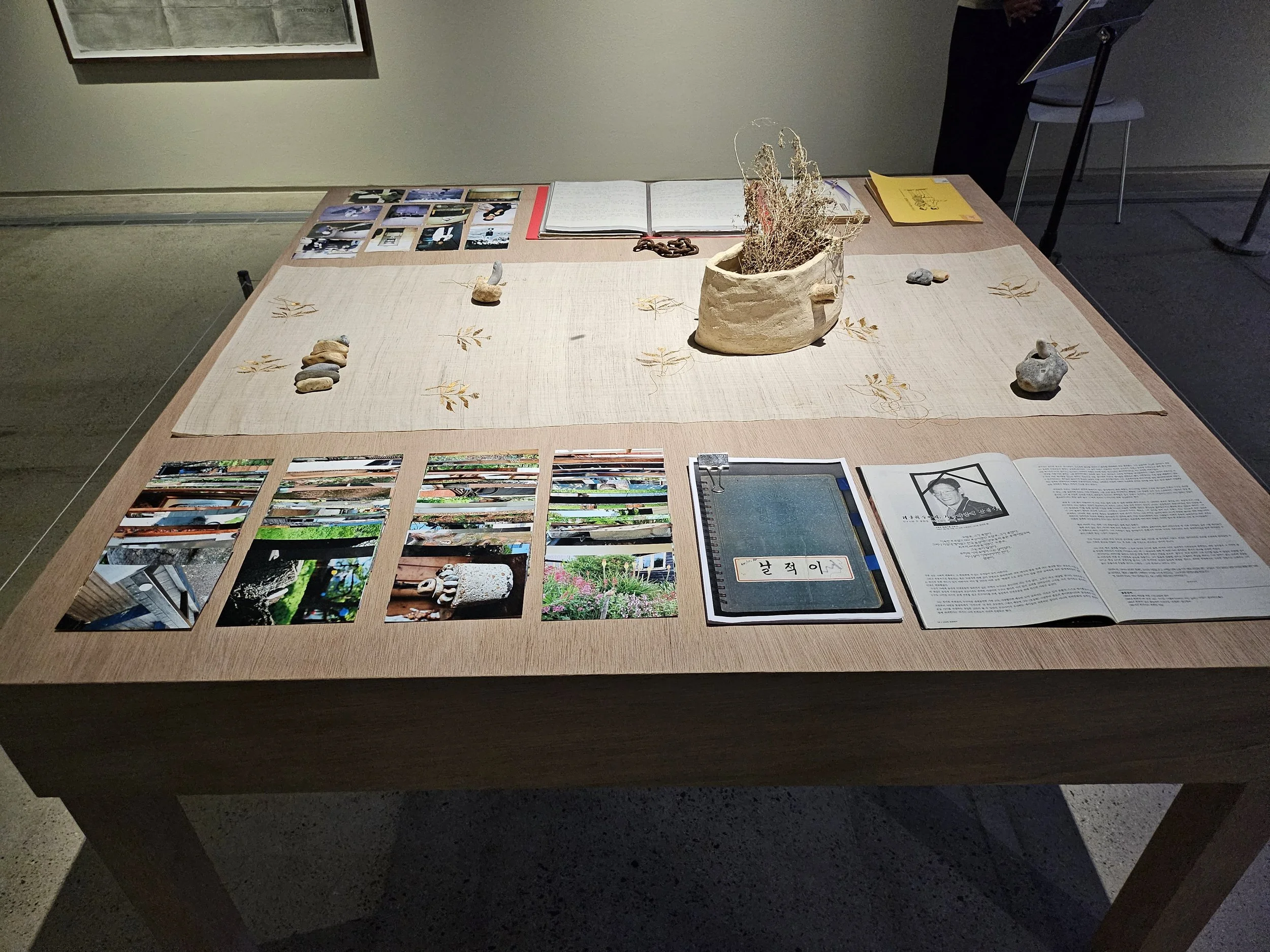
Kang Seung Lee, Untitled (Table), 2021. Korea Art Prize 2023, 20 Oct 2023- 31 Mar 2024, National Museum of Modern and Contemporary Art, Korea, Seoul, Republic of Korea) Courtesy of the author. Installation view of Untitled (Table), 2021. Archival materials related to the life of Joon-soo Oh and stitched plants arranged on a table.
In Garden, his exhibition at One and J. Gallery in Seoul, Lee wove together the lives of Derek Jarmen (UK, 1942-1994) and Joon-soo Oh (South Korea, 1964-1998). Both were artists and queer rights activists. Through film and writing, Jarmen and Oh, respectively, made queer lives more visible in their societies and challenged prejudice and discrimination. Lee traces the remnants of their lives by gathering natural objects such as stones and grasses, from gardens they once inhabited, Jarmen, notably, was also a gardener and Lee transposes those objects into embroidered forms on sambe, a traditional Korean hemp cloth.
Sambe is a biodegradable, plant-based textile woven from the fibers of the hemp plant, serving as the medium. Through the labor-intensive process of embroidering this material —which is destined to eventually disappear—the artist creates a record. This act strives to bring the lives of the queer communities—long excluded from the historical record, into the realm of history, while simultaneously highlighting the inherent fragility of the very act of documenting and preserving it.
***A notable aspect of Lee’s work lies not in simply recovering “unrecorded history”, but also in the processes by which it is restored and passed on. He looks beyond collection and preservation of records to consider the role of “caretakers”: people who hold memories and carry them forward to the next generation. Records do not endure on their own. It is only when someone cares for them, remembers them, and shares them with others that traces of the past can intersect with the present and forge new relationships. By connecting individuals across different eras, regions, and identities, as well as artists from diverse fields, Lee extends the transmission of memory beyond the boundaries of individual communities. Through this process, lives excluded from history are no longer confined to isolated personal experiences. Instead, they gain the potential to become part of a shared memory, where individuals can recognize and connect with one another.
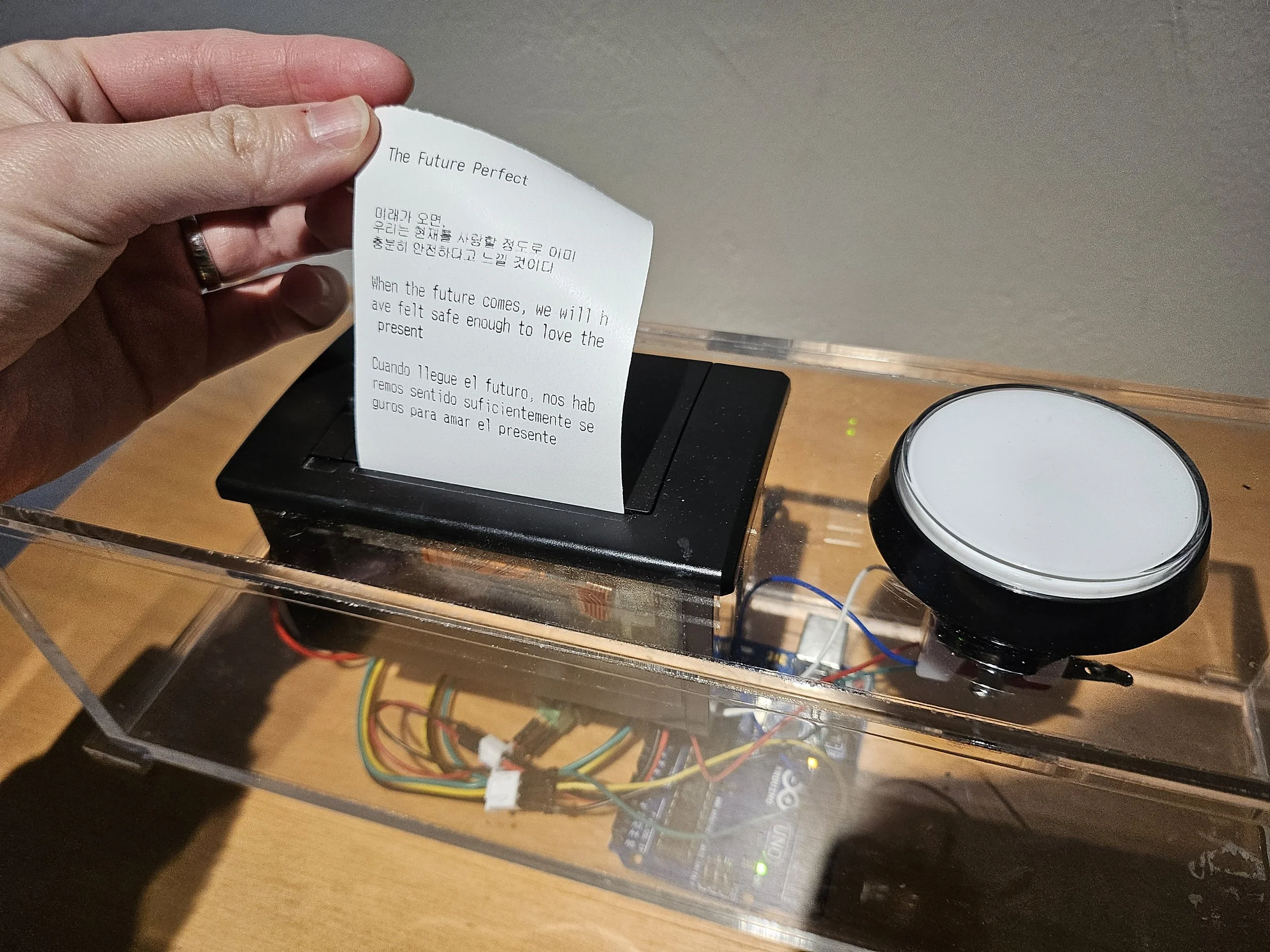
Kang Seung Lee, The Future Perfect, 2020. Korea Art Prize 2023, 20 Oct 2023- 31 Mar 2024, National Museum of Modern and Contemporary Art, Korea, Seoul, Republic of Korea. Courtesy of the author. Installation view of The Future Perfect, 2020. A small print displays a memo in Korean, English and Spanish that says “When the future comes, we will have felt safe enough to love the present.” The text appears when you press a button.
Caring for memories and passing them on goes beyond merely preserving a past that might otherwise be forgotten; it also offers a way to imagine a future yet to come. Kang Seung Lee’s work, The Future Perfect, utilizes the grammatical tense of the same name, which describes an action that will have been completed by a certain point in the future. Through this tense, the work invites us to envision what may already be accomplished when that future arrives. The phrase “When the future comes” which appears in the work, functions both as a question and a promise about a time that has not yet arrived.
What forms might the lives of those who currently remain under-documented and underremembered, take in the future? The practice of tending to memories and connecting the lives of people who lived in different times and places lays the foundation for collectively shaping that future. History is also an act of choosing what we decide to remember and pass on to the next future generations. Perhaps the history that will be recorded in the future begins the very moment we start remembering and connecting with one another’s lives today.
***
Kang Seung Lee (b. 1978, Seoul/Los Angeles) is a multidisciplinary artist working across drawing, embroidery, and installation. He participated in the Venice Biennale in 2024. His practice explores transnational queer histories, particularly their intersections with art history. Drawing on archival images, texts, and personal traces, he revisits the lives and legacies of marginalised figures. Through these works, he connects queer experiences across generations and geographies, creating space for remembrance and challenging omissions within dominant historical narratives.
Warmly,
Jeongwon Seo
Curator at the Busan Museum of Art
Jeongwon is interested in examining how capitalism shapes perception through propaganda, drawing on her studies in Business and Art Mediation.
Author: Jeongwon
Translator: Hyunjung
Editor: Haenee
Image: Jeongwon
