
Negative Space…
Negative space refers to empty space around the subjects of an image. In Japanese art and culture, ma (gap, space, pause) signifies the importance of an empty space, a blank space, space of absence, or I should say a space of (just) itself.
Every time I wrote about queer-related topics, I always mentioned how current research has always been ‘Anglo-centric.’ I am going to do exactly that here as well, especially on queer and Asian communities. In the Dutch context, it is always the Randstad area (and Utrecht), which have big Asian and diasporic communities. Do they live only in big cities?
Groningen is far from being an ‘empty space,’ it has visible queer communities and often invisible Asian communities. However, if you are both and are not Dutch speakers, you will easily feel or be excluded in these space(s). Compared to big Dutch cities like Rotterdam, The Hague, or Amsterdam, international students – of whom the city of Groningen has always boasted, being the youngest city in the Netherlands – usually do not stay and leave Groningen as soon as they graduated. Some of them do, and it is worth investigating why.
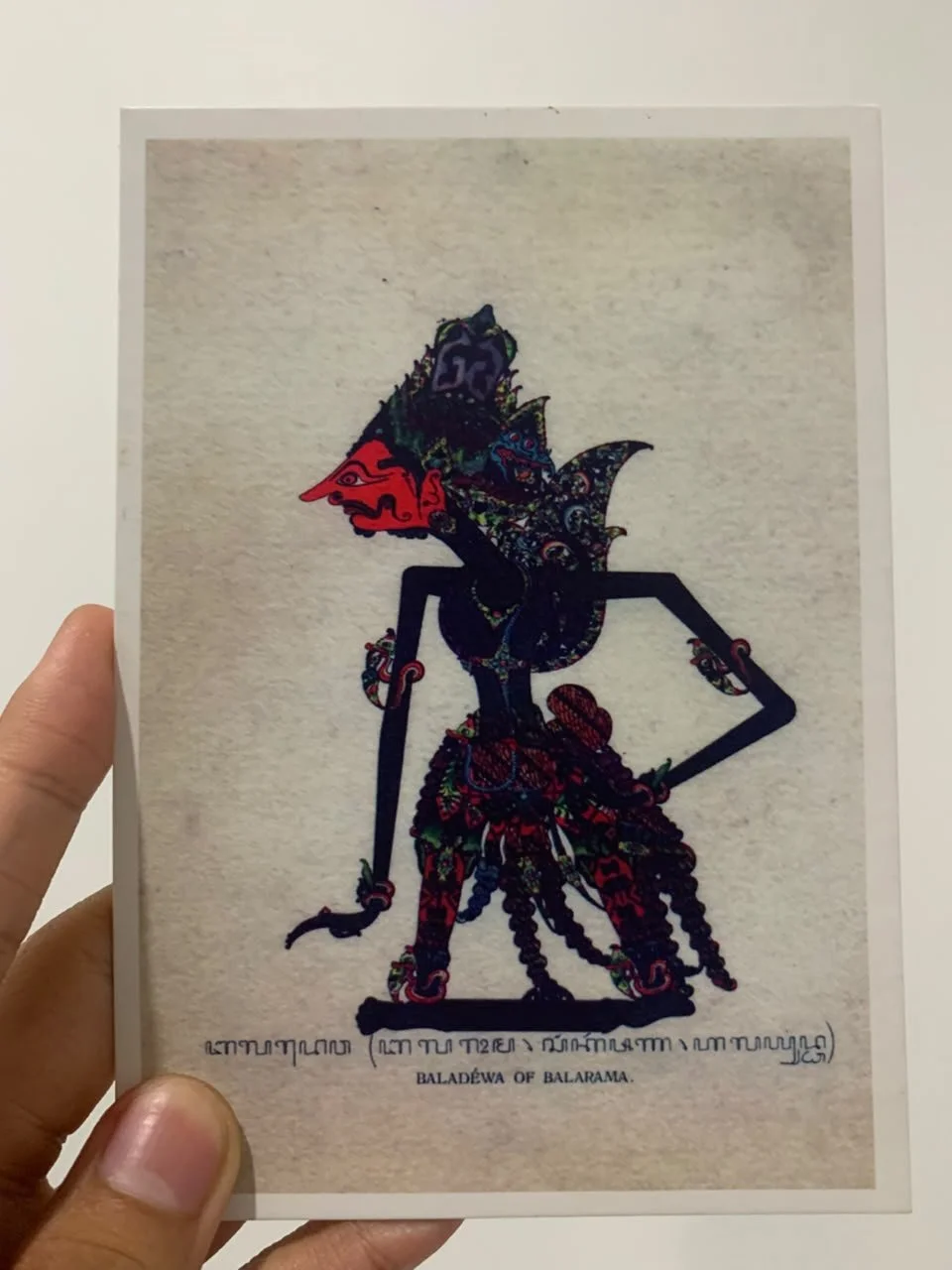
The empty background between and surrounding the wayang Indonesian shadow puppet (positive space) is called negative space, usually very present in Japanese paintings or art. Source: Author’s documentation of a postcard by Post Kantoor Cikni (Jakarta)
Positioning the Young, Asian, Queer Diaspora
I was one of those student who stayed and never left Groningen, at least until it demanded me to leave. Through my auto-ethnographic work and unstructured interviews with five young (20-35 years old) queer Asian diaspora, I am trying to make sense of the notion of Groningen as a ‘negative space.’
Asian here stresses the self-identification of different groups or individuals whose origin or roots can be traced to the Asian continent, rather than how they are viewed (racialised) and lumped together by Western society, as past research in the Dutch context usually focuses on East and Southeast Asia. I also go beyond the traditional Western notion of 'LGBTQ+ identity,' incorporating bodily experiences and everyday practices of people from a very broad spectrum of sexual orientation, gender identity, gender expression, and sex characteristics navigating sexualisation, homophobia, and discrimination, not necessarily an identity.
I am also not going to pretend that people of colour (especially the Asian diaspora in Groningen) are all monolith: minority, poor, and powerless. Many of them, I am included, come from pretty affluent backgrounds, especially since higher education in the Netherlands functions like a neoliberal institution, requiring them to be either excellent (See the concept of ‘Black Excellence’) to get a scholarship or very rich to be able to afford non-EU tuition fees.
Besides the fact that they are from the Global Majority, this also comes in tandem with them being young (which is neither just about being under 35 nor being students), but also the precarity that comes with it: job search, visa documents, not possessing enough resources by themselves, or being perceived as such by the society, especially during elections.
Oh, I thought Dutch people were very progressive!
A lot of (non-Dutch) people were surprised when I told them that I was called racist remarks such as ‘loempia,’ ‘ching chang chong,’ “small eyes.” As Gloria Wekker in White Innocence said, the Netherlands prided itself on being a small, innocent, and progressive (colour-blind and pro-LGBTQ+) nation.
For Indonesians, one of the ‘absences’ is the (post)-colonial trace and discussion in the public sphere in Groningen, rendering racism towards Asian lightly as a joke or conversation-starter, rather than a power play based on the logics of exclusion. Groningen’s colonial past has always been linked to the Dutch West Indies (WIC), (often) rendering its colonial ties to the Dutch East Indies (VOC) invisible as they outsource it to Amsterdam or The Hague.
The Netherlands has a history of racism in its colonies. In 1740, a pogrom (mass murder) against tens of thousands of Chinese-Indonesians was conducted in Batavia, Dutch East Indies, to repress a revolt. An apartheid-like racial hierarchy system was also introduced, positioning Chinese-Indonesians as 'Oost-vreemdelingen' (Foreign orientals) with Arabs and Indians, a separate foreign race from ‘the Natives,’ which is positioned at the very bottom.
As a queer person as well, I had teenagers asking me if I was a ‘mevrouw,’ shouting to me ‘homos!’ (gay in Dutch), and came up and harassed me at the Liberation Day Festival in Groningen (Yes, the irony). Homophobia and racism are intertwined, and I can be discriminated against as an Asian and queer person in the Netherlands.
In the Dutch East Indies, during the colonial rule of Tjarda van Starkenborgh Stachouwer, who comes from Groningen, the colonial police of the Dutch East Indies arrested more than two hundred officials, mostly European men, suspected of having sexual affairs with minors of the same sex, mostly native Indonesians (Javanese). Homosexuality in the colony, especially among natives, is to some extent tolerated because they were seen as already morally backward anyway. European homosexual behaviour shocked them way more.
From “Why haven’t you come out in Indonesia?” to “I don’t usually date Asians”
I have come to terms with how my story of being a queer person from (regressive) Indonesia to (progressive) Netherlands seems to be an conversations at every queer space. One topic I still find annoying is when someone (a stranger I have met for 15 minutes) ask if I came out to my parents already and keeps on insisting to do it.
To be a valid member of the LGBTQ+ movement, coming out seems to be a prerequisite, and your identity as a non-Dutch queer person depends on this. The burden of having to face possible conversion therapy, ostracisation, losing your parents, or simply that coming out is less important than your relationship with your parents – they will simply never get this.
People often assume that queer spaces have always been welcoming to all (queer) people. Queer spaces in Groningen are predominantly white and again, whiteness does not mean blank or empty nor just a category. It represents power relations that function in these spaces. Those who dress up in a certain way, who has come out (plus point if your family accepts you), are rich, has a high-paying job, and are (well)-documented (has permanent residence or a European passport).
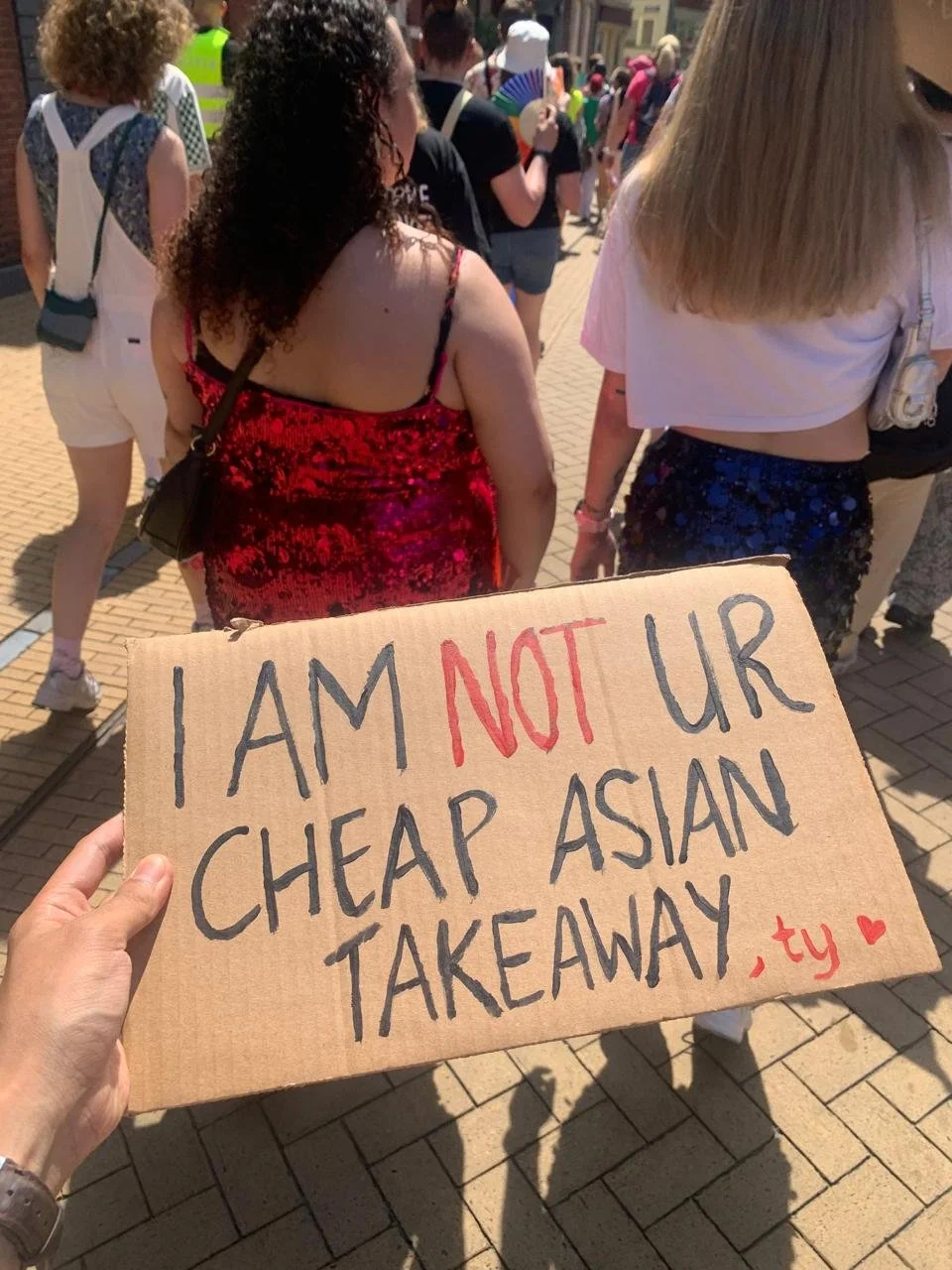
A protest sign referring to the fetishisation of Asian people, equating it to cheap Asian takeaway. Source: Author’s own documentation
Being ‘Asian’ is like a genre you can choose to date or not to date. The recent ‘Love is Blind’ controversy revealed to us how Dutch society has normalised ‘racial preference.’ The man in the show saying that he "wouldn't fall for a fully Black woman" truly reminds me of how I am used to hearing "I do not usually date Asians." Asian men are often seen as emasculated and undesirable, and their masculinity is seen as confusing, while Asian women are overly sexualised and exoticised.
***
Weg tot het Westen (Djalan ke Barat or The Way to the West)
A publisher in Groningen (J. B. Wolters, 1929) produced this Dutch language book for the natives in the Dutch East Indies. The cover features a European woman positioned higher, looking down and guiding a Javanese woman through the stairs and to read. It signifies how learning Dutch in the colony was seen as a gateway to Western education and civilisation, a ladder for upward social mobility.
Eventually, this now applies to migrating and becoming Dutch as well. The common trope for a lot of Asian queer community is that migration, especially to the West, is an adventure and a (self)-discovery and that they have a certain imagination of Europe, the saviour of the savagery of their country of origin.
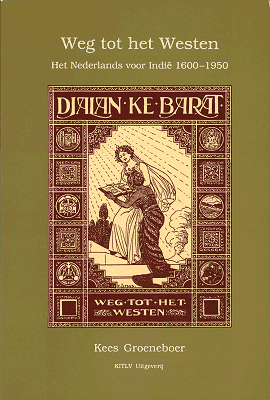
Dutch language book titled Weg tot het Westen (in Dutch) or Djalan ke Barat (in Indonesian) used in the Dutch East Indies. Source: Digitale Bibliotheek voor de Nederlandse Letteren (DBNL)
***
However, the Netherlands is not a utopia for queer Asians. In fact, racism towards (South)-east Asians has worsened since the Covid-19 pandemic, and a 2026 study found that younger people have become less tolerant towards the LGBTQ+ community, especially amidst the rise of far-right politics and anti-gender movements.
A space does not automatically feels home and sometimes can feel so hostile, especially a ‘negative space’ which requires more labour for you to connect with the communities there. A space requiring you to blend in to the background (in Dutch, ‘doe normaal’), while being visibly not so. We often forget the -ing in belonging signifies that it is an active process, requiring agency, and that includes not only learning Dutch, but also going through a lengthy, painful, often humiliating process of paperwork or inburgering (becoming a citizen). My research back then did not include people seeking asylum, but I have met them on different occasions.
However, Groningen, for them, offers a space to breathe and to detach from the hustle and bustle of big cities. A few of them still travel to Randstad for queer and/or Asian-related events. However, many of them chose to stay since the city is more quiet and less overwhelming. This gives them the space and energy to be actively imagining their own belonging, not just participating or integrating, but actively shaping it.
Amelia (a pseudonym), a community organiser, is pretty active in the activism scene in Groningen, while never detaching herself from the struggles in Indonesia. Mega, a spoken word artist, has performed all around the Netherlands. Trang found their home in the Netherlands by organising events in a local LGBTQ+ student association. Vina connects with their Dungeon and Dragons circle and church in their neighbourhood and is actively practicing Dutch. Last but not least, Serena has been actively leading a student association.
Through my encounter, interestingly, visibility is not always something Asian queer communities in Groningen wants. Even Vina said to me that queerness for her is like the glasses she wore; it does not define who she is wholly, meaning that queerness does not define their identity.
Longing in Be-longing
An important element of belonging in a ‘Negative Space’ is longing: an imagined process, a desire, a feeling of wanting to be included. Mega said it would be nice not to feel special and to have more space in Groningen that truly includes people of colour. For Mega, belonging is not just also a feeling, but also surviving, from learning Dutch to then getting the right treatment as part of the transgender and intersexual community, and building your support system from scratch.
Longing posits belonging not as a linear process, but as fragmented and often unreciprocated. For instance, Serena hopes for people in Groningen to immediately stop asking where she is from, as she felt immediately rendered as a foreigner. For some, it is also conditioned. Trang and Vina told me that they wish to find a stable job to be able to stay. Respondents also said they attach and detach from different communities (Pasar malam event, gay bars, student associations) as a choice of navigating belonging and unbelonging.
Longing also convey some sort of melancholia, especially in a 'Negative Space' where the subject might be far away or difficult to get. Amelia wishes someday (religious) communities back home would be more accepting so that she can tell her parents. At the same time, Amelia is also actively re-imagining it by actually organising events in the city and participating in online communities connecting people who has roots in the Southeast Asian archipelago in the Netherlands.
For me, this research and the writing itself also reflect the longing for belonging. The city does not have a visible Chinatown, nor visible queer Asian event like in the big cities in the Randstad. A lot of the Asian Dutch community in Groningen or Friesland has migrated to the big cities. Our communities are rather fragmented, with international students from Asia coming and leaving Groningen. However, we are there, at some point, negotiating belonging in a space that (in)-visibilises us.
***
Muhammad Anugrah Utama or Tama (they/he) is a doctoral student at Palacky University in Czechia who did their master’s study at the University of Groningen. Their interests include EU-ASEAN relations and broadly gender, sexuality, youth movements, including anti-racism and the Asian diaspora in the Netherlands. I can be reached via LinkedIn, Instagram, or my personal email muhanugrahutama@gmail.com
