
What exactly is Queer Asian Month? How was this idea born? What does it mean for the people behind it ? To find out, AVE had a chat with Ann Li, one of the people who brought this initiative to life.
Ann is a vibrant and vocal woman who seems to have an endless supply of energy: she juggles work, raises her son with dedication and, in her spare time, somehow manages to co-create Untold Asian Stories (UAS). When we asked her what people should take away from UAS, she immediately highlighted its mission to welcome “everybody who connects, or wants to connect with their Asian roots, whatever form that connection takes, whether through adoption, being a first, second or third-generation Asian, having Asian heritage, etc.”. Listening to her answer, we could tell that this desire to offer a community a sense of belonging comes from something she herself lacked growing up–something we suspect many of us can relate to.
Today, UAS offers a diverse range of activities, from providing a precious break and a safe(r) space for Asian diasporas to connect with one another, celebrate and take pride in their roots and explore new possibilities through creative and artistic projects, to organizing public awareness-raising events. And, of course, whenever possible, these events gather everyone around a yummy Asian meal!
So now, it’s time for her to tell her own story!
***
Could you introduce yourself?
My name is Ann, a co-founder of Untold Asian Stories. Untold Asian Stories is now 5-year-old and we did our first event 5 years ago on September 11. It was a movie night.
How did Untold Asian Stories start?
I was told that, in Leuven, the city where I live, Chinese people made up the largest group of non-EU residents. Leuven is quite a small town of just over than 100,000 residents. There were more than a 1,000 registered Chinese residents, as well as a big community of people from Nepal and India. That means there are actually large communities with Asian roots.* That came as a surprise to me because they are so invisible here.
*In January 2026, Belgium’s population was more than eleven million inhabitants. 36,6% were Belgian citizens of foreign origin and non-Belgian citizens, in which 6,7% were of West Asian origin (corresponding to approximately 2,45% of the total Belgian population) and less of 5% of East Asia and Oceania origin (less than 1,83% of the total Belgian population) (Stabel, 2026a, 2026b).
I got curious and started looking into that. Then I connected with a cultural organization here in Leuven called “Nihao Leuven”. I felt very welcome. They were speaking Chinese and sharing Chinese food. All the smells and dishes from my childhood were there. But then I realized that I still didn’t truly belong there. I could understand easy conversations in Chinese, but my vocabulary isn’t very big; and I also had different experiences growing up in Belgium. I felt we should start something for ourselves. That was also around the time when I read about ‘third culture’ and this in-between space, when you grow up between two cultures, and you don’t really know your own space.
At that time, I read an interview series with Lotus Li. In the interview, Lotus said that there wasn’t enough representation of Asian people in Flanders. So I looked Lotus up on Instagram and sent her a message, “You’re Asian and I’m Asian. Do you want to do something together?” And Lotus replied “what do you want to do?” That’s kind of how it started. In the beginning, I thought about doing stories like Humans of New York, but with people with Asian roots throughout Belgium. If you look at our first couple of posts, there are some interviews. But Lotus said, “No, we also have to do events every month”. I said, “You’re crazy, but if you want to do that, go ahead.”
***
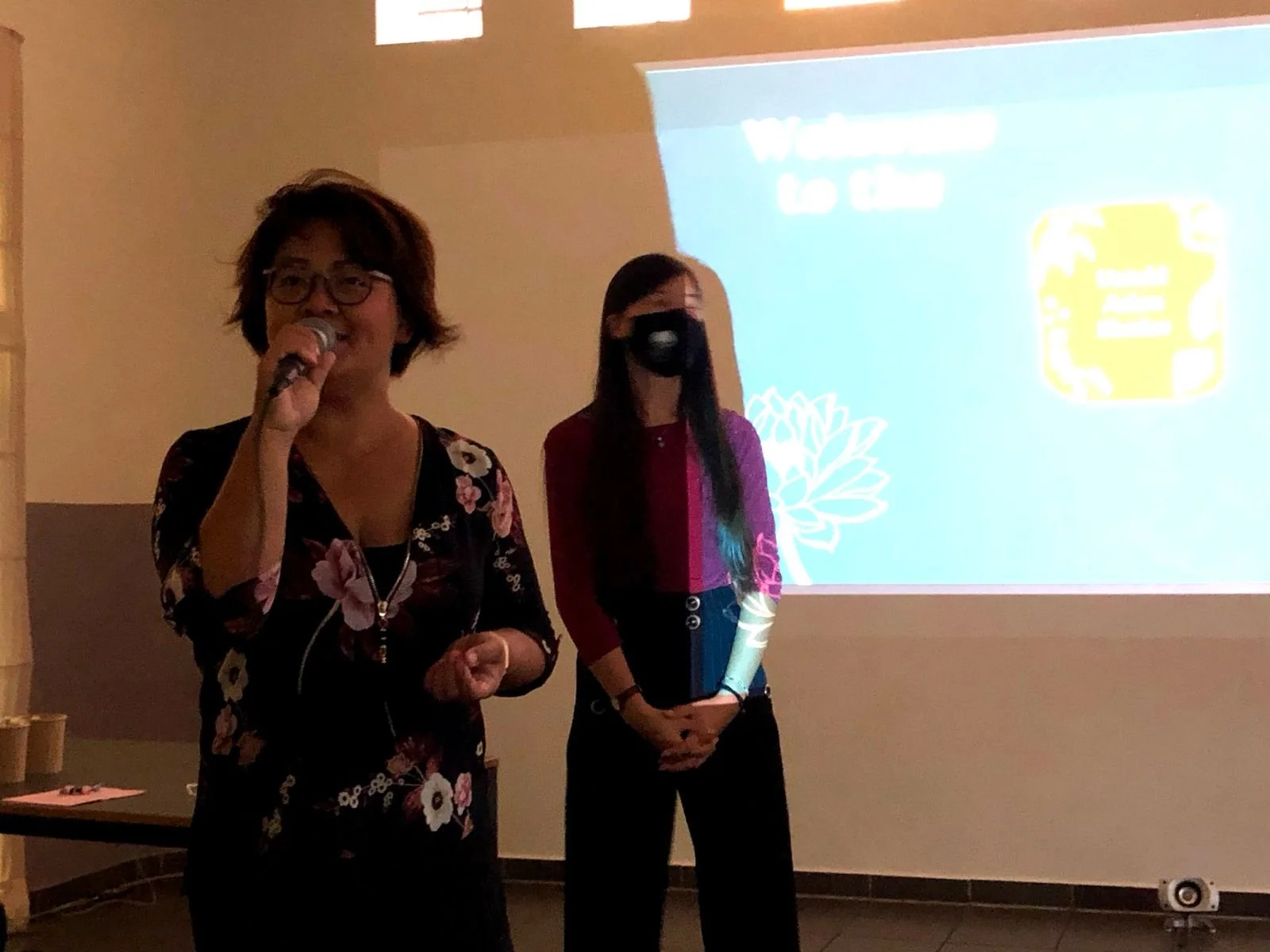
Ann speaking at the first UAS event. Photo Credit: photographer unknown.
Over the years, we evolved from sharing stories on Instagram to connecting with people around the intersectionality of whatever we found interesting. Lotus was adopted, so we did events around adoption and I work in the mental healthcare sector, so I did panels on mental healthcare. We also saw that there was no space for Asian creators or Asian artists at that time, so we organized two Asian expos, Unseen Asian Stories.
***
Mental healthcare and well-being have become important parts of Untold Asian Stories. What have you noticed throughout this work?
I grew up in the ‘80s and ‘90s in Leuven. Growing up, I always felt like I was the only Asian in Belgium. People with Moroccan and Turkish roots have quite big communities, but there is a lot of racism against them. But Asians were rather invisible. The racism I felt was also invisible. It helped me so much to hear panelists [at the workshops organised by AVE in Berlin last August] talk about internalized racism. I think we have so much internalized racism going on, and we don’t even realize how many of our feelings we push aside. We tell ourselves, “It’s nothing big. We just have to be strong. Never mind them. They don’t know better.” But still, it hurts.
A young woman shared her story with me : “I hate my eyes. I hate my eyes because people were bullying me so badly because of my eyes. I can’t stand seeing myself in a picture. I always wear sunglasses, even when it’s inside, even when it’s winter.” I was just in shock. How is this possible? Then, when I told a friend of mine that story, she said, “I also have that. I used to tape my nostrils before going to bed every night because I hoped my nose would become smaller.” It makes me feel so sad that those things are happening. And that’s how the idea of organizing a safe space event came about. For the first one, we were around 15 people with Asian roots, talking about experiences across different ages.
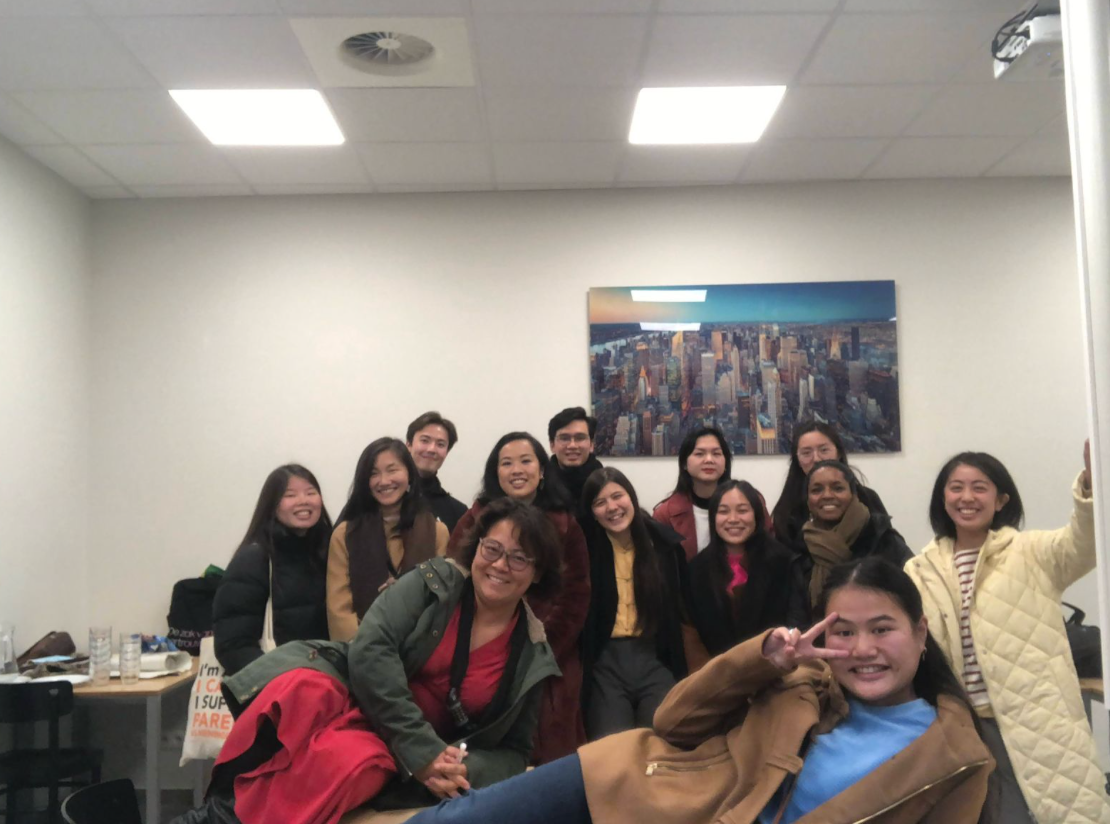
First safe space. Photo Credit: photographer unknown.
For me, Untold Asian Stories is also a story about finally feeling that it’s possible to have this space where we can share those feelings and process everything that has happened. It’s about finding kindred spirits to talk about these experiences. I’m very conscious about not taking on too many things myself because I have to pace myself. Otherwise, it might be too much for me to take in.
But then, how do we create a safer space for people of color to talk about identities, but also about how we can become stronger ourselves? I don’t want other people to take our power away anymore. We need to think about how we can take our own power back and how we can stand our own ground.
***
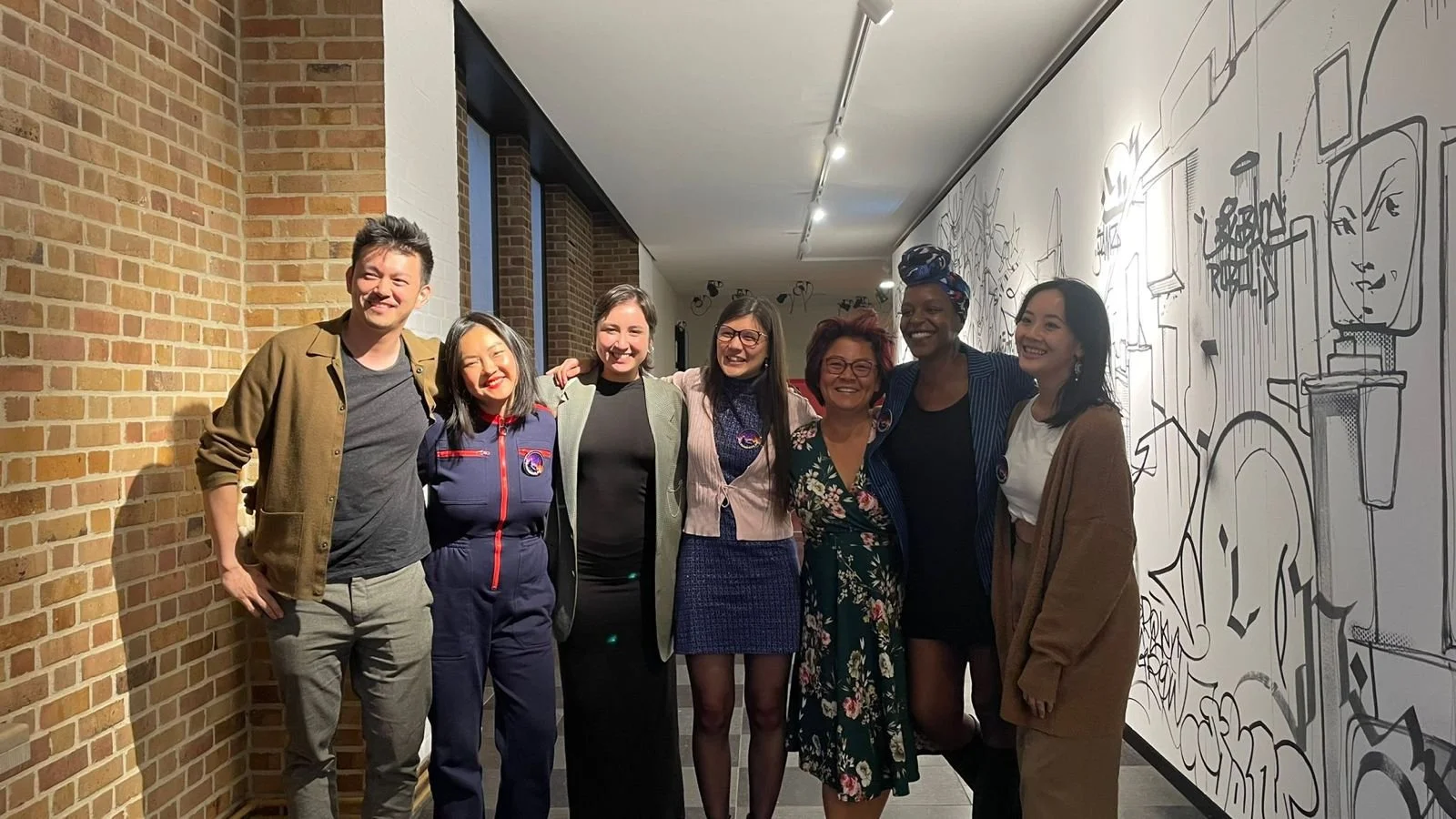
Belmundo Express. Photo Credit: photographer unknown.
Untold Asian Stories was also awarded by Sparkle Award for diversity for initiating Queer Asian Month. What was the objective of this initiative? Are you planning to do so this year as well?
Lotus and I are both queer, and we didn’t know any other queer Asians at that moment. In 2022, we had already been talking about it for two years, “Let’s do something, but what shall we do?” Then Lotus was like, “No worries, we’re just gonna do something!” There was a queer film festival in Leuven, so we went there together to see movies. We also had an open mic. We were connected with several small queer organizations in Leuven and started working together. KC from Untold Asian Stories performed during our first open mic. There was also another person who played the ukulele and sang a song. Somebody started dancing. It was so heartwarming. We thought, “Okay, we have to do this again next year.”
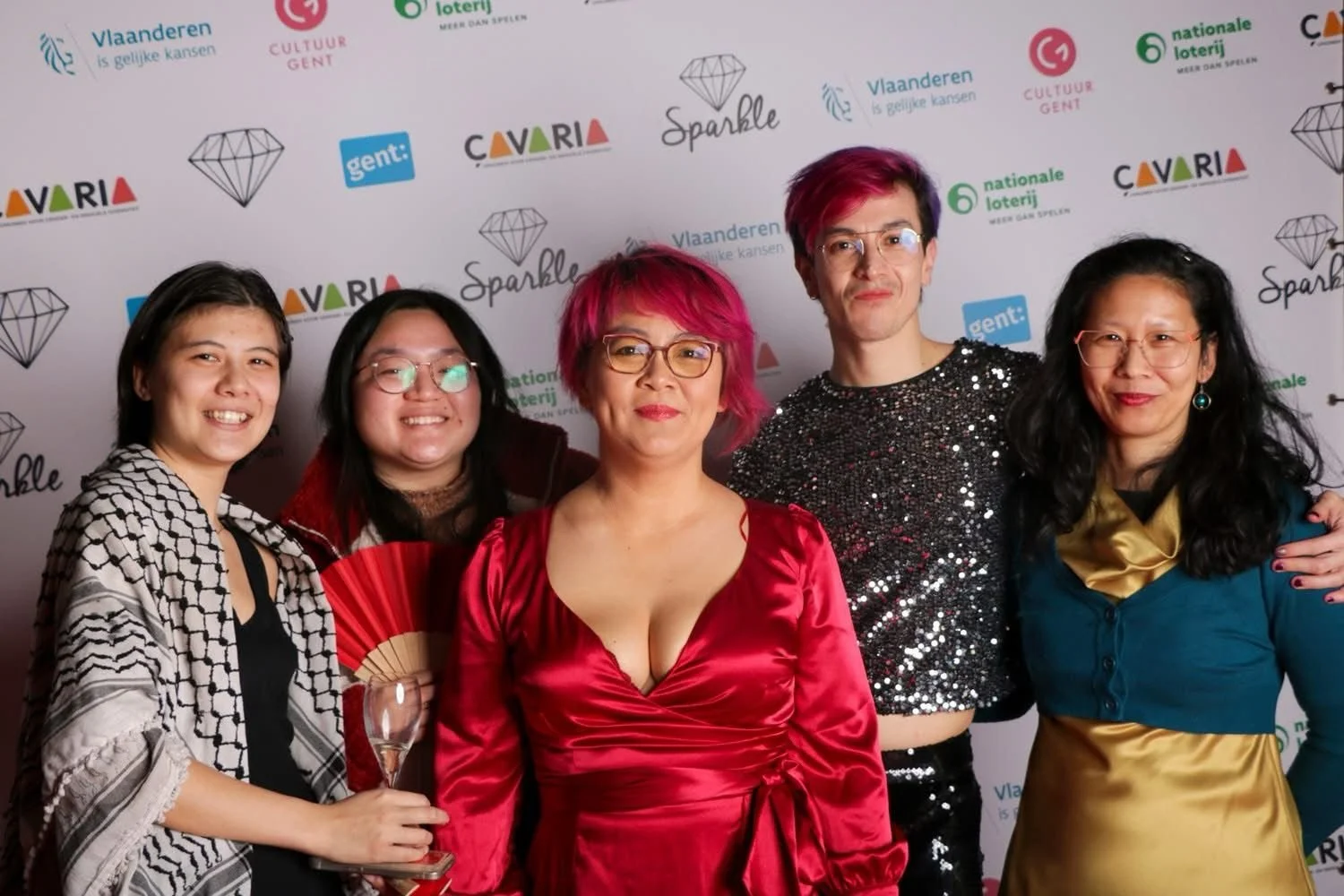
UAS at Sparkle Award 2024 . Photo Credit: Photo Credit: photographer unknown.
In the following year, Untold Asian Stories organized another open mic, a queer Asian safe space, and a drag show. One of the queer organizations knows a lot of drag queens, and we invited three Asian drag queens. KC and I performed our first drag act. Last year, we did a drag workshop where people could come and learn how to do drag makeup. One of our biggest dreams is to organize a trajectory where queer Asians can come, we teach them drag makeup, help them develop an idea of an act, and organize an event where we all perform together as a community.
From the outside, Untold Asian Stories look like a large organization. What does it actually look like behind the scenes?
Oh god, there are so many challenges on so many levels. We are a grassroots organization. This is all in our spare time. On a personal level, it is always a difficult exercise in balancing me being too enthusiastic about things and then feeling kind of on the edge of burnout.
Financially, we practically have no money. We got a small funding from the city of Leuven, and we mostly used them for finding a platform where we can talk safely and creating space for a digital archive. We don’t want to become an institutionalised organization that just goes from one agenda point to another..
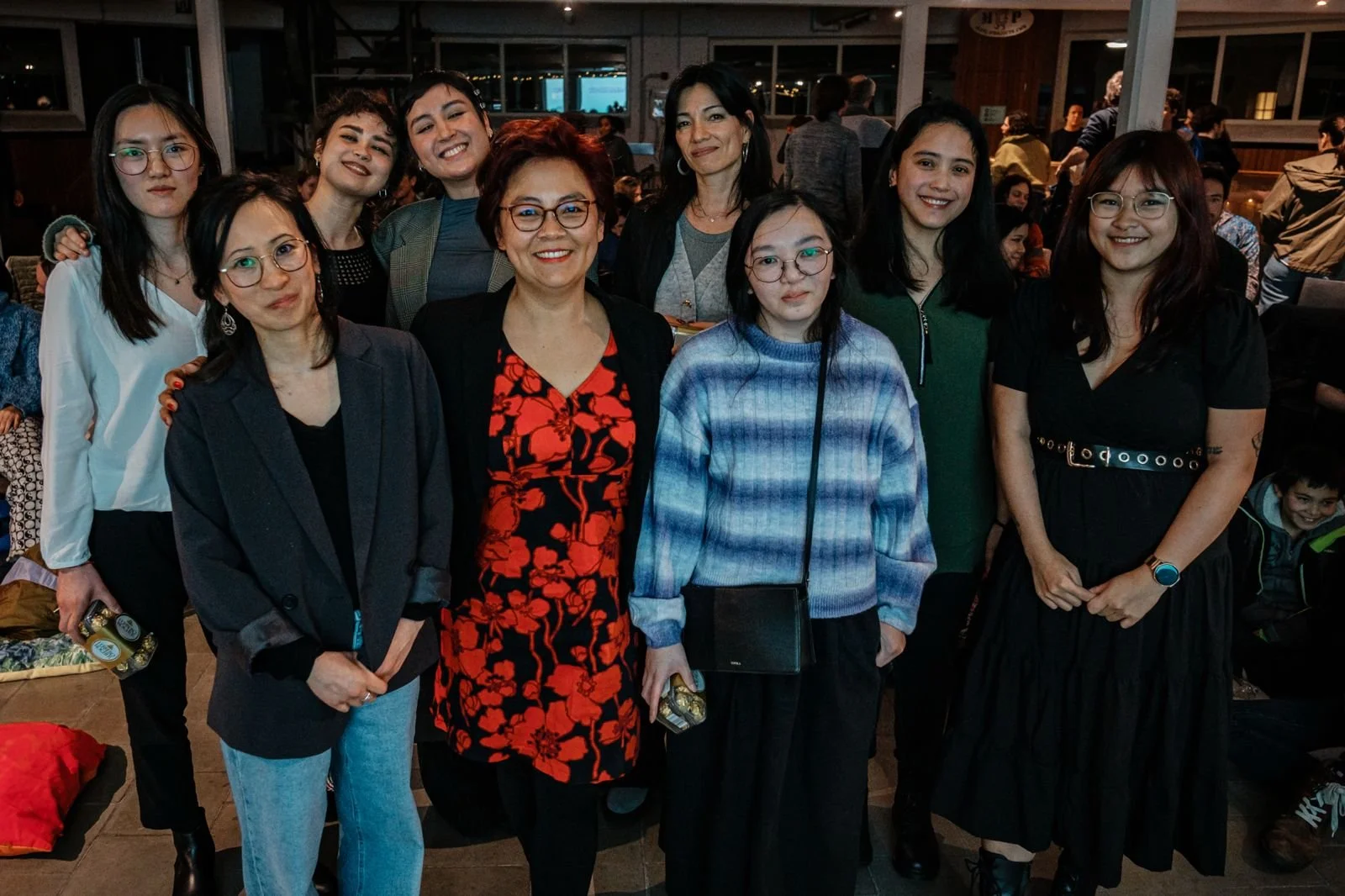
Panel on Asian racism during Unseen Asian Stories in collab with LEVL. Photo Credit: Raf Balrak
One of the next steps of Untold Asian Stories is to offer media and debate-training for some of our members. What we’ve experienced is that talking to the press or appear on television requires a certain level of communication skill. You have to know how to talk to television makers. Sometimes, if you go on a panel, it can be fun to talk there, but it can also retraumatize you. It is easy to be angry at politicians and be mad about how things are going. But if we want to work together on a constructive level, we have to understand how political institutions work as well.
Recently, you were interviewed in the media following the song using the CCC word. How did you feel about this?
My first thought was, “Oh god, this again.” Because this has been my whole life. At first, I actually didn’t want to react. Then I realized that blocking it out is also a trauma response like, “You do not exist anymore.” Other people were feeling all the pains again. It meant going back to their childhood and reliving all the times that people said that word to them. It is hurtful. I was invited to De Afspraak, and they prepared five questions, but television moves very quickly. In the end, the presenter only asked me one question. I felt very frustrated because I never got to say what I wanted to say.
The following day, I was invited to the television program De Tafel van Gert where I sat in the studio together with FabioW (who made the song with the CCC word). I was really happy that I could speak out and it meant a lot to the community. But two things happened afterwards: I’m used to having people criticizing me, but this time. Asian people were also trolling me and calling me a spineless coward for not being angrier. But for Asian women, staying calm in a public interview can be a strategy to avoid the Dragon Lady stereotype, as women are often judged more harshly than men when they express anger publicly. So, I was hurt and had no energy left for that. I was just so empty. I underestimated the possible effect on me. I also still had to work and I still had to be a mom.
With all these challenges what still motivates you to continue this work?
I think it’s because I also need a space like this for myself to process things, where we can find the people and can talk about feelings and experiences. This kind of community is what we all need. A few years ago, my son was in elementary school and somebody at school said the CCC word to him. He was really shocked because that was the first time. The school didn’t handle it well, and his friends didn’t handle it well. I said to him, “This is why I created Untold Asian Stories”. I told him we could write down his story together and share it on Instagram so that he could see how much support he had. So we did.
There were so many people saying many sweet things to him. He felt seen. He felt acknowledged in the fact that this hurts. He realized that there are people who bully you, but there are also people out there who can support you. I think having this space helps him not to feel alone. And I hope others have that experience as well.
***
What is the one thing you would like our subscribers to take away from this interview?
“You’re not alone, even though sometimes it feels like that.”
***
Are you living in Belgium and looking to connect with Asian diaspora communities? Check out Untold Asian Stories on Instagram, especially for the Queer Asian Month programme! From creative events to spaces for sharing experiences, there are plenty of ways to meet community people!
***
Author: Hyunjung, Veronica
Editor: Kennis
Photo credit: Ann Li, Raf Balrak
